Programs Offered
Master of Science
The School of Electrical Engineering & Computer Science offers the following Master of Science degree programs available for students on the WSU Pullman and WSU Tri-Cities campuses unless specified:
- Artificial Intelligence M.S – Thesis or Non-Thesis Program
- BS + MS AI – Project Option only
- Computer Engineering M.S. – Thesis or Non-Thesis
- Computer Science M.S. – Thesis or Non-Thesis
- Electrical Engineering M.S. – Thesis or Non-Thesis
- Software Engineering M.S. – Non-Thesis online program
Doctor of Philosophy
The School of Electrical Engineering & Computer Science offers the following Doctor of Philosophy degree programs available for students on the WSU Pullman, WSU Tri-Cities and WSU Vancouver campuses:
- Computer Science Ph.D.
- Electrical & Computer Engineering Ph.D.
Research Areas
Computer Science
- Artificial Intelligence & Machine Learning
- Algorithms & Theory of Computing
- Bioinformatics & Computational Biology
- Computer Networks & Distributed Computing
- Cybersecurity & Cryptography
- Data Science
- Formal Methods & Programming Languages
- High Performance Computing
- Software Engineering
Electrical & Computer Engineering
- Power Engineering
- Microelectronics
- Electromagnetics & Optical Communications
- Control Systems
- Signal Processing & Communications
- Embedded Systems
EECS Graduate Admission
Admission
The School of Electrical Engineering & Computer Science evaluates applicants for admission to its graduate programs based on college transcripts, undergraduate/graduate GPA, GRE score, letters of recommendation (minimum of three), a Likert scale, a statement of purpose and English language proficiency score (if applicable).
Apply online at the Graduate School and select the Engineering Applications.
Applications will be evaluated by the EECS Graduate Studies Committee and applicants deemed most qualified will be recommended to the Graduate School for admission. Please note that admission may be denied by the Graduate School if an applicant does not meet the minimum university standard for admission.
Program Admission Prerequisites
Artificial Intelligence
Before undertaking graduate study in Artificial Intelligence, the student should have completed a Bachelors or baccalaureate degree substantially similar to the BSCS, BS SE, BS Cyber-Security degree described in our schedule of studies. An undergraduate grade point average of 3.0 is a minimum for admission to the MS program.
Students with Non-Computing Background
The MS in AI graduate program requires sufficient knowledge in computer programming, algorithms, and core mathematical concepts (e.g., probability, statistics). We expect most students with bachelor’s in engineering disciplines, physics, mathematics, and statistics to have this background. For all non-computing students, we will provide educational materials and course modules to pick up these skills as needed without taking extra courses.
Computer Engineering
Specific Admission Recommendations for Students with non-Computer Engineering Background:
Students whose undergraduate studies did not include material equivalent to that covered in the following WSU courses may be asked to take coursework to resolve that deficiency: CPT_S 121, 122, 360, E_E 214, 234, 324, 334, & MATH 216. The committee may require the student to complete other undergraduate deficiencies including courses that are prerequisite to graduate courses. These courses cannot be used towards the Program of Study.
Computer Science
Specific Admission Recommendations for Students with non-Computer Science Background:
Students whose undergraduate studies did not include material equivalent to the following WSU courses may be asked to take coursework to resolve that deficiency: CPT_S 121, 122, 223, 260, 317, 350, 355, 360, PHIL 201, & MATH 216. The committee may require the student to complete other undergraduate deficiencies including courses that are prerequisite to graduate courses. These courses cannot be used towards the Program of Study.
Electrical Engineering
Specific Admission Recommendations for Students with non-Electrical Engineering Background:
Students whose undergraduate studies did not include material equivalent to that covered in the following WSU courses may be asked to take coursework to resolve that deficiency: E_E 214, 234, 261, 311, 321, 331, 352, & any three of E_E 341, 351, 361, or CPT_S 360. The committee may require the student to complete other undergraduate deficiencies including courses that are prerequisite to graduate courses. These courses cannot be used towards the Program of Study.
Software Engineering
The School of Electrical Engineering & Computer Science evaluates applicants for admission to its graduate programs based on college transcripts, undergraduate/graduate GPA (minimum 3.0), letters of recommendation (minimum of three), a statement of purpose, and an English language proficiency score (if applicable). GRE is not required for admission to Online M.S. in Software Engineering program.
Program Admission Prerequisites
Specific Admission Recommendations for Students with non-Software Engineering and non-Computer Science Background:
Students whose undergraduate studies did not include material equivalent to the following WSU courses may be asked to take coursework to resolve that deficiency: CPT_S 131 or 121, CPT_S 132 or 122, CPT_S 233 or 223 or 215. These prerequisites can be waived if the applicant has taken equivalent courses in other institutions or if they have extensive industry experience in programming and/or software engineering. The admission committee will review the transcripts and applicant’s work experience and suggest prerequisites that need to be completed (if any). These courses cannot be used towards the Program of Study
Required Application Materials
Graduate Record Exam (GRE)
The School of Electrical Engineering & Computer Science requires official scores for the general GRE as a part of the application package. There is no published minimum GRE score requirement for admission. GRE scores are not required for the Software Engineering online program. Presently GRE is optional.
English Language Proficiency
All international applicants must demonstrate a basic proficiency in English by submitting official Test of English as a Foreign Language (TOEFL), International English Language Testing System (IELTS), or Michigan English Language Assessment Batter (MELAB) test scores. Scores must be less than two years old at the time of expected semester enrollment and sent directly to the Graduate School from the Educational Testing Service.
Please note the following exceptions to the English proficiency requirement:
- Applicants from Australia, Bahamas, Barbados, Botswana, Canada, Guyana, Kenya, United Kingdom, Republic of Ireland, Jamaica, New Zealand, Nigeria, and Trinidad & Tobago are exempt from the English proficiency requirement.
- International students who have or will have graduated with a baccalaureate-level or higher degree from an accredited four-year U.S. or Canadian college or university within two years of the expected semester of enrollment at the WSU Graduate School are not required to submit English proficiency test scores.
The ETS institutional code for WSU and the minimum acceptable TOEFL scores can be found on the Graduate School webpage for international applicant requirements.
Letters of Recommendation
It is required that all applicants have at least three letters of recommendation submitted. These letters of recommendation can be academic or from a place of employment, or a combination.
Applicants should contact their references ahead of time to be sure they are willing to respond to the request for a recommendation. Applicants should ask them to discuss their leadership, academic standards, and skills as they pertain to the applicant’s primary interest area. All references will be contacted automatically through the online application system when their information is entered on the application.
Transcripts
Unofficial transcripts are required for every college and university that the applicant has attended are required for the application review process. International applicants should supply unofficial transcripts in both the native language and an English translation. Applicants may upload copies of unofficial transcripts (and translations) via the online application.
Official transcripts will not be required until an applicant has been recommended for admission by the department. Any transcripts sent to the Graduate School as part of the application or admission process cannot be returned or transferred. All official transcripts must be delivered to the Graduate School in a stamped and sealed envelope.
Graduate Student Classifications
Advanced Degree Candidates
Regular Degree Seeking
This classification is for students admitted to the Graduate School with previous coursework averaging 3.0 or higher. This cumulative grade point average is taken from the graded undergraduate work or the graded graduate study of 12 semester hours or more taken after the receipt of a bachelor’s degree. International students in this classification must have a grade point average equivalent to a U.S. grade of “B” or better in the last two years of coursework.
Provisional Degree Seeking
This classification is for students whose previous work, as defined above, is below 3.0. Provisional status may be granted because of special departmental recommendations or other indications of outstanding potential. A provisional degree seeking student must maintain a 3.0 GPA or higher; automatic reinstatement for first semester students whose GPA falls between 2.75 and 2.99 does not apply to provisionally admitted students. If a provisionally admitted student falls below a 3.0 GPA in their first semester of study, the department may choose not to reinstate the student.
Not Advanced Degree Candidates (NADC)
This classification is for those students with a baccalaureate degree who apply to a graduate program, but are not recommended by the graduate program for admission at the time of application. Generally, applicants are recommended to the NADC classification by the graduate program because the program has determined that the applicant is not academically prepared and additional preparatory work is necessary before they will be considered for admission. Admission as NADC does not obligate the graduate program to admit the student to a degree program in the future.
Students may be admitted as NADC with less than a 3.0 cumulative GPA, but must maintain a 3.0 GPA once admitted. These students may take any course for which they have the necessary prerequisites, except those at the 700- or 800- level.
A maximum of six credit hours of graduate coursework with grades of “B” or higher (nine for non-thesis master’s or doctoral degree) earned under NADC classification (and post-baccalaureate) may be applied to graduate degree, Program of Study, requirements. Post-baccalaureate students must complete and submit a Reservation of Graduate Credit form for approval at the time of registration. Time limits on the coursework are the same as for transfer credit.
General Academic Requirements
Enrollment
Students Receiving Financial Support
Each Graduate Student receiving financial support from the School of Electrical Engineering & Computer Science in the form of a Teaching Assistantship (TA), Research Assistantship (RA), or a Fellowship must register for at least ten credit hours. At least nine of those credits should be graded courses unless the student is near the end of their program and coursework is near completion. The remainder of the credits may consist of research credits, E_E/CPT_S 700 or 800.
Students considering dropping or withdrawing from a course that will put them below the enrollment requirements listed above should have the approval of their faculty advisor, International Programs (if applicable), and the Graduate Studies Committee.
International Students
International students are responsible for maintaining their own visa status, with the assistance of the International Programs office.
Typically, students must be enrolled in at least ten credits in order to be considered full-time and maintain their visa status. Students may apply for a Reduced Course Load via the International Programs office if less than ten credits are remaining for completion of their degree. Note that an approved Program of Study must be on file with the Graduate School before a student is able to apply for Reduced Course Load.
Continuous Enrollment
Master’s Degree Students
All master’s degree students are required to enroll for a minimum of two credits every fall and spring semester until they complete all of their degree requirements. Graduate Leave is available to those degree-seeking students who are in good standing, but must be away from campus for personal reasons. See Graduate School Policies & Procedures for more information regarding Graduate Leave, including Internship Leave: Official Graduate Leave of Absence. Please note that international students must consult with International Programs regarding personal or internship leave and discuss the enrollment requirements with them.
If a master’s degree student does not register for credit or go into approved Graduate or Internship Leave status, their absence is considered to be unapproved. Such students may reenroll and will need to pay a $25 reenrollment fee if they are absent for less than three semesters (excluding the summer). Reenrollment also requires departmental approval and is not guaranteed. Students who are absent for three consecutive semesters (excluding the summer) will be dropped from the Graduate School.
Doctoral Students
Prior to Preliminary Exams
Prior to taking preliminary exams, all doctoral students are required to enroll for a minimum of two credits every fall and spring semester until they complete all of their degree requirements. Graduate leave is available to those students who are in good standing, but must be away from campus for personal reasons. See Graduate School Policies & Procedures for more information regarding Graduate Leave, including Internship Leave: Official Graduate Leave of Absence. Please note that international students must consult with International Programs regarding personal or internship leave and discuss the enrollment requirements with them.
If a doctoral student does not register for credit or go into approved Graduate or Internship Leave status, their absence is considered to be unapproved. Such students may reenroll and will need to pay a $25 reenrollment fee if they are absent for less than three semesters (excluding the summer). Reenrollment also requires departmental approval and is not guaranteed. Students who are absent for three consecutive semesters (excluding the summer) will be dropped from the Graduate School.
After Successful Completion of Preliminary Exams
After successful completion of preliminary exams, doctoral students are expected to continue to enroll for research credits each semester until they defend their dissertation. There is a three-year deadline from the date of the preliminary exam to the date of degree completion. Students who have taken their preliminary exams, have met all of their program requirements except completion of their dissertation, and do not have the funding to register for two or more research credits will be placed into Continuous Doctoral Status (CDS) for a limited number of semesters. Students in CDS will be charged a $50 per semester administrative fee and will have limited access to University resources. See Graduate School Policies & Procedures for more information regarding CDS: Continuous Enrollment for Degree-Seeking Students.
Transferring Credits from External Institutions
Regulations
Graded graduate-level coursework (with a grade of B or higher) taken toward a master’s degree at an accredited institution may be used toward a doctoral degree at WSU per approval via the based on the process outlined below. However, graded graduate-level coursework taken toward a completed master’s degree may not be used toward another master’s degree at WSU. All other graduate-level coursework (with a grade of B or higher) taken as a graduate student, but not taken toward a completed graduate degree, may be used toward a master’s degree or a doctoral degree at WSU per approval via the process outlined below. In all transfer cases, the number of transferrable credit hours is limited to no more than half of the total graded course credits required by the program as outlined in later sections of the EECS Graduate Student Handbook. None of the transferred credit used to complete a degree at WSU may be applied toward another advanced degree.
All transfer course requests must have an equivalent course that has been taught within the School of EECS at WSU; special topics courses that do not have an equivalent counterpart at WSU will not be considered for transfer. Only six total credits of Special Topics courses may be transferred for use on your Program of Study. No core courses used toward your degree requirements may be transferred.
Transfer credits are subject to the usual time restrictions for master’s or doctoral degrees and certificates, and approval by the department and Graduate School. Credits cannot be more than six years old for a master’s or certificate program and ten years old for a doctoral degree at the time of graduation.
Procedure
- Students must have all transfer coursework evaluated and approved prior to the submission of the Program of Study; all transfer processes should be initiated within the first year of enrollment in an EECS graduate degree program.
- With the support of their faculty advisor, a student will create a program of study draft, identifying the courses to be transferred and how they will be applied to the student degree. The program of study draft form (example in Appendix) can be found on the EECS graduate student webpages or requested from the Graduate Program Coordinator.
- The student will complete a transfer request form (example in Appendix) for each course that they wish to transfer. Each form, available online or from the Graduate Program Coordinator, must be accompanied by supporting materials including a syllabus, transcripts, course materials, textbook information, etc.
- The program of study draft and all transfer request forms must be submitted in a packet with one petition to transfer graduate coursework cover page (example in Appendix). This packet should then be submitted, electronically or hard copy, to the Graduate Program Coordinator.
- Once the completed packet has been received, the Graduate Program Coordinator, in coordination with the GSC, will select an appropriate faculty member to review the content of each course to determine if it is approved for transfer.
- The student should keep a copy of all transfer materials and approval letters for submission with the official Program of Study.
Graduate Student Evaluations
All Students
Each year the progress of every student will be reviewed by their faculty advisor. A written and signed copy of this evaluation will be placed in the student’s file. A copy of this evaluation is available to the student on request. This review, conducted by the EECS Faculty, should indicate the student’s progress on coursework and research, when applicable. The evaluation will occur at the end of the spring semester, unless there is a reason for a fall review.
Teaching Assistants
Performance of Teaching Assistants (TAs) will be evaluated by the instructor and the students for the course(s) to which they are assigned. Instructors will have evaluation distributed and collected by the Graduate Program Coordinator, available to the student on request. Students will have the opportunity to evaluate TA performance during the course evaluation process, available for review in the semester after the review was completed. The student evaluation process is not conducted by the department or the Graduate Program Coordinator.
Assistantship Renewal
The Graduate Studies Committee will review all data available, including student evaluations and TA evaluations, at the time of the assistantship renewal process. Students may not be reappointed if performance and academic progress are deemed unsatisfactory.
Maximum Timeframe for Degree Completion
Ph.D. Program
Most students enrolled in doctoral degree programs at WSU require 4-6 years for completion of their program. There are two-time limitations for doctoral students:
- The maximum time allowed for completion of a doctoral degree is ten years from the beginning date of the earliest course applied toward the degree. This means that the courses (including transfer coursework) on the Program of Study remain valid for only ten years from the earliest date of the courses being applied toward the degree.
- The doctoral degree must be completed within three years of the date of satisfactory completion of the Preliminary Examination.
It is imperative that students work closely with their advisor and committee to develop a timeline for completion that successfully accommodates both of these deadlines. At least four months must lapse between the Preliminary and Final Doctoral Examinations.
M.S. Program
Most full-time students enrolled in master’s degree programs at WSU require 2-3 years for completion of their program. The maximum time allowed for completion of a master’s degree is six years from the beginning date of the earliest course applied toward their degree (including transfer coursework).
B.S + M.S. in Artificial Intelligence Program (4+1 Program)
An accelerated BS + MSAI (4+1) pathway is available to qualified WSU students.
This program is similar to the Masters in Artificial Intelligence Project Option with 30 credits and allows using up to six credits of graded coursework from the bachelor’s degree.
The Accelerated BS + MSAI (4+1) program is intended for WSU students only, enrolled in the BS in Computer Science, BS in Computer Engineering, BS in Software Engineering, and BS in Cybersecurity programs who wish to obtain both a bachelor’s degree and a Master of Science in Artificial Intelligence in an accelerated manner. The program allows qualified students to begin graduate coursework during their senior undergraduate year and complete the MSAI degree with an estimated additional year of study, although some students may need three semesters to complete all degree requirements including coursework and the graduate AI capstone project.
This program is available with project option only.
Graduates will be well prepared to develop, deploy, and advance AI technologies across a rapidly growing range of industries and application domains.
Students who do not have a 4- year degree in Computer Science, Computer Engineering, Software Engineering and Cybersecurity might be required to complete additional coursework.
Credit Sharing
Up to six credits of coursework may satisfy the requirements for both the bachelor’s and master’s degrees, subject to University and Graduate School regulations.
Several MSAI core courses have undergraduate counterparts that may have been completed during the student’s bachelor’s degree program (e.g., CPT_S 440/540 Artificial Intelligence and CPT_S 434/534 Neural Network Design).
Procedure to Request Extension to Degree Completion
For students who are not able to complete their degree within the specified maximum timeframe outlined above, you may request an extension to the degree program.
Students may request up to three extensions, however none of these extensions are guaranteed to be approved by the student’s advisor, department, or the Graduate School. Policies and procedures for extension requests are located in the Graduate School Policies & Procedures.
Grade Requirements
Minimum GPA
Deficiency
Graduate students are required to maintain a minimum of 3.0 cumulative GPA. Those who fall below this threshold are considered deficient and may be subject to dismissal.
Reinstatement
Graduate students whose cumulative GPA falls below a 3.0 are considered academically deficient and must be reinstated in order to continue in the program. In order to apply for reinstatement for the following semester, the student’s faculty advisor will need to send a memo of support to the Graduate Program Coordinator. The student will also need to meet with the Graduate Program Coordinator and GSC Chair to discuss an academic plan to raise the cumulative GPA above a 3.0, or at least obtain a 3.3 GPA in the subsequent semester. Students who obtain a 3.3 semester GPA but still do not meet the cumulative 3.0 GPA requirement are permitted to apply for a second reinstatement.
Core Course Grade Requirements
M.S. Degree Grade Requirements
All core and required courses (as listed within the relevant degree area) must be passed with a B- or better. Core courses will be indicated by the student on the Core Course, Focus Area, & Minor form (example in Appendix).
Ph.D. Grade Requirements
All core and required courses must be passed with a B or better, unless otherwise noted. Core courses and minor area will be indicated by the student on the Core Course, Focus Area, & Minor form (example in Appendix).
Retaking Courses
A student that receives a grade of C- or less will be able to register to take that class again on their own. If a student earns a grade of C or higher, but does not meet the departmental required grade for a course, they will need to submit a Petition to Add, Drop, or Withdraw from Courses (as found on the Graduate School’s Forms webpage) to the Graduate Program Coordinator during the next semester in which the course is offered. The student will explain on the form that they did not meet the required grade based on departmental regulations and get signatures from their advisor and the course instructor before submitting the form to the Graduate Program Coordinator.
Program of Study
Definition
The Program of Study (available on the Graduate School Forms page) is an official form documenting the student’s plan for courses to take as well as indicating their research interests. For master’s degree students, the Program of Study should be filed with the Graduate School as soon as possible, but no later than the beginning of the semester preceding the anticipated semester of graduation. For example, if a student plans to graduate in the spring, the Program of Study is due no later than the beginning of the preceding fall semester. For doctoral students, the Program of Study must be filed with the Graduate School before the end of the third semester of study (October 1 deadline for fall; March 1 deadline for spring). The student’s faculty advisor, in consultation with suggested committee members, should assist the student in the development of their proposed Program of Study.
General Requirements
In addition to satisfying the academic requirements of your program, as presented in this handbook, all Program of Study must meet the Graduate School requirements as listed in the Policies & Procedures manual on the Graduate School website.
Filing the Program of Study
After the proposed Program of Study form is completed by the graduate student, it must be signed by each advisory committee member and submitted to the Graduate Program Coordinator for approval. Once the Graduate Program Coordinator has determined that the Program of Study matches the minimum guidelines for a student’s chosen program and Focus Area(s) as applicable, it will be given to the GSC Chair or EECS Director for signature. The Graduate Program Coordinator will then submit the form to the Graduate School for their final approval based on departmental and university wide requirements.
Changing the Program of Study
Changes made to the Program of Study must be documented with the appropriate signatures, signifying the endorsement of the committee chair and the approval of the Chair of the program, and submitted to the Graduate School. If program changes are made, the Program Change form must be completed, signed, and submitted to the Graduate School before a student applies for their degree through Application for Degree and Graduation Form.
Fulfilling the Program of Study
Once approved and submitted, the Program of Study becomes the basis of the course requirements for the degree. As noted on the Program of Study form itself, any course listed on an approved Program of Study must be completed with a grade of C or better. If a course is not completed with a C or better, it must be retaken, and an appropriate grade earned, before the student can graduate. A course with a grade lower than a C cannot be removed from the Program of Study.
Guidelines for Directed Study
E_E or CPT_S 595
The student and their directed study instructor will provide an abstract of the planned work by the end of the second week of the semester. A copy of the abstract must be filed with the Graduate Program Coordinator for enrollment.
A report describing the work must be submitted at the end of the semester. If a conference or journal paper or Tech Report is generated, a separate report is not necessary.
Master’s Degree Requirements
Thesis Option
Course Requirements
Students in the M.S. Artificial Intelligence – Thesis program must complete the following coursework for their Programof Study:
- 33 total credits – minimum
- 24 graded credits – minimum
- 18 E_E/CPT_S credits – minimum
- 6 credits non-graduate (400-level) credits – maximum
- 6 transferred credits – maximum
- 3 Directed Study credits (E_E/CPT_S 595) – maximum
- 9 CPT_S 700 credits – minimum
- 24 graded credits – minimum
- Any undergraduate coursework assigned to the student to make up for undergraduate deficiencies at the time of admission may not be used toward the student’s degree.
In order to ensure that each student obtains a reasonable graduate-level understanding of a number of fundamental areas, each M.S. Artificial Intelligence – Thesis student must complete the following course requirements with a grade of B- or better:
- Core Courses (12 credits) – All core courses are mandatory and must be completed.
- CPT_S 540 Artificial Intelligence
- CPT_S 570 Machine Learning
- CPT_S 534 Neural Network Design
- CPT_S 545 AI in the Real-World
- Advanced courses (6 credits)
- CPT_S 580 Reinforcement Learning
- CPT_S 541 Computer Vision
- CPT_S 544 Generative AI
- CPT_S 580 Distributed ML
- Electives (6 credits)
- CPT_S 515 Advanced Algorithms
- CPT_S 516 Algorithmics
- CPT_S 571 Computational Genomics
- CPT_S 575 Data Science
- CPT_S 580 Randomized Algorithms
- CPT_S 591 Elements of Network Science
- Math 566 Network Optimization
- Math 529 Introduction to Computational Topology
- Math 567 Integer and Combinatorial Optimization
- ME485 – Introduction to Robotics and AI
- ME 579 AI in Advanced Manufacturing (as approved by the Graduate Studies Committee)
- EE 582 Convex Optimization
- Other special topic courses such as AI+X (as approved by the Graduate Studies Committee.
Final Examination – Thesis Defense
The student must file an Application for Degree form with the Graduate School on or before the deadline date specified by the Graduate School; this is an online process and submission.
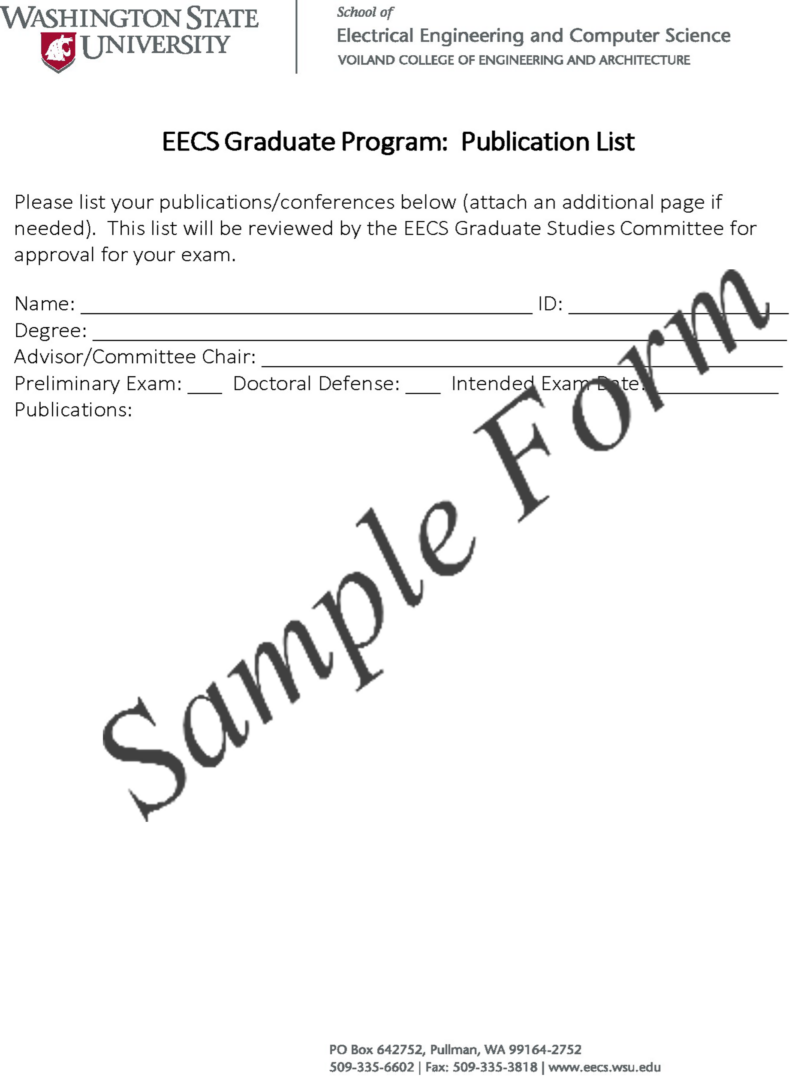
The final examination should be scheduled after the student has completed all required coursework, applied for the degree, and had their thesis approved by their committee. A List of Publications should also be submitted to the GSC prior to scheduling of exam as per the EECS publication policy. The list should include all publications submitted, accepted, or in preparation as well as the full name of the conference or journal for which they were submitted and the (anticipated) date of submission or appearance. The scheduling form must be submitted to the Graduate Program Coordinator a minimum of three weeks in advance of the examination date. Note that the student must be enrolled in a minimum of two CPT_S 700 credits during the final exam semester.
If the student’s thesis is approved and the oral defense is passed, the student must provide a digital copy of the thesis to the School of EECS. The thesis must be formatted in accordance with University and Graduate School requirements, and all changes suggested by the student’s committee must be made in the final version. Students are encouraged to submit the results of the thesis research to a refereed journal or conference.
Project Option
The project option is well-suited for students aiming to get trained in the use, implementation, and application of AI, grounded on a strong foundation in the fundamentals of AI and machine learning. The project option provides an opportunity for students to complete a substantial capstone project under the guidance of a faculty mentor. Students graduating with an MSAI (Project) will be well-prepared to join the AI industry across a wide range of sectors (including but not limited to technology, health, manufacturing, energy) and apply AI methods to solve real-world problems.
Non-Thesis Option
Course Requirements
Students in the M.S. Artificial Intelligence – Program must complete the following coursework for their Program of Study:
- 30 total credits – minimum
- 26 graded credits – minimum
- 18 E_E/CPT_S credits – minimum
- 6 credits non-graduate (400-level) credits – maximum
- 6 transferred credits – maximum
- 3 Directed Study credits (E_E/CPT_S 595) – maximum
- 4 CPT_S 702 credits – minimum
- 26 graded credits – minimum
- Any undergraduate coursework assigned to the student to make up for undergraduate deficiencies at the time of admission may not be used toward the student’s degree.
In order to ensure that each student obtains a reasonable graduate-level understanding of a number of fundamental areas, eachMS Artificial Intelligence project student must complete the following course requirements with a grade of B- or better:
- Core Courses (12 credits) – All core courses are mandatory and must be completed.
- CPT_S 540 Artificial Intelligence
- CPT_S 570 Machine Learning
- CPT_S 534 Neural Network Design
- CPT_S 545 AI in the Real-World
- Advanced courses (6 credits)
- CPT_S 580 Reinforcement Learning
- CPT_S 541 Computer Vision
- CPT_S 544 Generative AI
- CPT_S 580 Distributed ML
- Electives (9 credits)
- CPT_S 515 Advanced Algorithms
- CPT_S 571 Computational Genomics
- CPT_S 575 Data Science
- CPT_S 580 Randomized Algorithms
- CPT_S 591 Elements of Network Science
- Math 566 Network Optimization
- Math 529 Introduction to Computational Topology
- Math 567 Integer and Combinatorial Optimization
- ME485 – Introduction to Robotics and AI
- ME 579 AI in Advanced Manufacturing (as approved by the Graduate Studies Committee)
- EE 582 Convex Optimization
- Other special topic courses such as AI+X (e.g., AI for Advanced Manufacturing) approved by the Graduate Studies Committee.
Final Examination
Project Presentation
The student must file an Application for Degree form with the Graduate School on or before the deadline date specified by the Graduate School; this is an online process and submission.
The final examination should be scheduled after the student has completed all required coursework, applied for the degree, and completed a written project report approved by the project advisor. The scheduling form must be submitted to the Graduate Program Coordinator a minimum of three weeks in advance of the examination date. Note that the student must be enrolled in a minimum of two credits during the final exam semester in accordance with Graduate School requirements.
The final examination consists of a written project report (10 pages) and an oral presentation with demonstration of the project. The presentation will be held as part of the School of EECS MSAI Capstone Poster Expo, at the end of each academic semester. The project should demonstrate the student’s ability to apply advanced AI and machine learning concepts, tools, and techniques to address a real-world problem, software system, or research-inspired application. The project should represent a substantial piece of independent work and is expected to require effort comparable to a graduate-level capstone experience.
If the student’s project report is approved and the project presentation is passed, the student must provide a digital copy of the final project report to the School of EECS. The report should be prepared in a professional format acceptable to the faculty advisor, and all changes suggested by the examining committee must be incorporated into the final version. Students are encouraged to disseminate project outcomes through open-source software, technical reports, industrial collaborations, conference papers, or other appropriate venues.
The Accelerated BS + MSAI (4+1) program is intended for WSU students only, enrolled in the BS in Computer Science, BS in Computer Engineering, BS in Software Engineering, and BS in Cybersecurity programs who wish to obtain both a bachelor’s degree and a Master of Science in Artificial Intelligence in an accelerated manner. The program allows qualified students to begin graduate coursework during their senior undergraduate year and complete the MSAI degree with an estimated additional year of study, although some students may need three semesters to complete all degree requirements including coursework and the MSAI project.
This program is available with project option only.
Transition to Graduate Status
Students will only be granted graduate student status after the completion and conferral of their undergraduate degree. Students must satisfy all Graduate School admission requirements and be formally admitted to the MSAI program.
Credit Sharing
Up to six credits of coursework may satisfy the requirements for both the bachelor’s and master’s degrees, subject to University and Graduate School regulations.
Several MSAI core courses have undergraduate counterparts that may have been completed during the student’s bachelor’s degree program (e.g., CPT_S 440-Artificial Intelligence and CPT_S 434 Neural Network Design, CPT_S471 and CPT_S 466).
CPT_S 437 Machine Learning cannot be used as a replacement for CPT_S 570 Machine Learning.
For students in the Accelerated BS + MSAI (4+1) program, approved undergraduate conjoint courses may be used to satisfy the corresponding MSAI core course requirements as part of the shared six credits.
Students may receive credit for only one version of a conjoint course. Therefore, once the undergraduate version of a conjoint course has been used to satisfy the bachelor’s and MSAI degree requirements through the approved shared-credit mechanism, the corresponding graduate version may not be taken or counted again toward the MSAI degree.
Project Option
Course Requirements (BS + MS, 4+1)
This program is similar to the Masters in Artificial Intelligence Project Option with 30 credits and allows using up to six credits of coursework from the bachelor’s degree. The requirement for the remaining 24 credits is as follows:
Students in the M.S. Artificial Intelligence (4+1 Program) – Thesis program must complete the following courseworkfor their Program of Study:
- 30 total credits – minimum
- 24 graded credits – minimum
- 6 credits from undergraduate conjoint courses (400 level) credits- maximum
- 18 E_E/CPT_S credits – minimum
- 3 Directed Study credits (E_E/CPT_S 595) – maximum
- 3 credits from Electives – Minimum
- 3 CPT_S 702 credits – credits corresponding to the capstone project
- 24 graded credits – minimum
- Any undergraduate coursework assigned to the student to make up for undergraduate deficiencies at the time of admission may not be used toward the student’s degree.
- CPT_S 437 Machine Learning cannot be used as a replacement for CPT_S 570 Machine Learning.
In order to ensure that each student obtains a reasonable graduate-level understanding of a number of fundamental areas, each Accelerated BS + MSAI (4+1) program student must complete the following course requirements with agrade of B- or better:
- Core Courses – (12 credits minimum)
- CPT_S 540 Artificial Intelligence
- CPT_S 570 Machine Learning
- Note: CPT_S 437 Machine Learning cannot be used as a replacement for CPT_S 570 Machine Learning.
- CPT_S 534 Neural Network Design
- CPT_S 545 AI in the Real-World
- Advanced courses (minimum of 6 credits)
- CPT_S 580 Reinforcement Learning
- CPT_S 541 Computer Vision
- CPT_S 544 Generative AI
- CPT_S 580 Distributed ML
- Electives (minimum of 3 credits)
- CPT_S 515 Advanced Algorithms
- CPT_S 571 Computational Genomics
- CPT_S 575 Data Science
- CPT_S 591 Elements of Network Science
- CPT_S 580 Randomized Algorithms
- Math 566 Network Optimization
- Math 529 Introduction to Computational Topology
- Math 567 Integer and Combinatorial Optimization
- ME485 – Introduction to Robotics and AI
- ME 579 Al in Advanced Manufacturing as approved by the Graduate Studies Committee)
- EE 582 Convex Optimization
- Other special topic courses such as AI+X – (as approved by the Graduate Studies Committee)
Final Examination – Project Defense
The student must file an Application for Degree form with the Graduate School on or before the deadline date specified by the Graduate School; this is an online process and submission.
The final examination should be scheduled after the student has completed all required coursework, applied for the degree, and completed a written project report approved by the project advisor. The scheduling form must be submitted to the Graduate Program Coordinator a minimum of three weeks in advance of the examination date. Note that the student must be enrolled in a minimum of two credits during the final exam semester in accordance with Graduate School requirements.
The final examination consists of a written project report (10 pages) and an oral presentation with demonstration of the project. The presentation will be held as part of the School of EECS MSAI Capstone Poster Expo, at the end of each academic semester. The project should demonstrate the student’s ability to apply advanced AI and machine learning concepts, tools, and techniques to address a real-world problem, software system, or research-inspired application. The project should represent a substantial piece of independent work and is expected to require effort comparable to a graduate-level capstone experience.
If the student’s project report is approved and the project presentation is passed, the student must provide a digital copy of the final project report to the School of EECS. The report should be prepared in a professional format acceptable to the faculty advisor, and all changes suggested by the examining committee must be incorporated into the final version. Students are encouraged to disseminate project outcomes through open-source software, technical reports, industrial collaborations, conference papers, or other appropriate venues.
Thesis Option
Course Requirements
Students in the M.S. Computer Engineering – Thesis program must complete the following coursework for their Program of Study:
- 30 total credits – minimum
- 21 graded credits – minimum
- 18 E_E/CPT_S credits – minimum
- 6 credits non-graduate (400-level) credits – maximum
- 6 transferred credits – maximum
- 3 Directed Study credits (E_E/CPT_S 595) – maximum o 9 E_E 700 credits – minimum
- 21 graded credits – minimum
- Any undergraduate coursework assigned to the student to make up for undergraduate deficiencies at the time of admission may not be used toward the student’s degree.
In order to ensure that each student obtains a reasonable graduate-level understanding of a number of fundamental aspects of computer engineering, the student must successfully complete at least three of the following Core Courses with a grade of B- or better:
- Core Courses
- E_E 524/CPT_S 561 – Advanced Computer Architecture
- E_E 530 – Digital Signal Processing II
- E_E 586 – VLSI Systems Design
- Note: If E_E 586 is not available, E_E 466 (VLSI Design) may be substituted
- E_E 587 – System on Chip (SoC) Design & Test
- Note: If E_E 587 is not available, E_E 434 (ASIC & Digital Systems Design) may be substituted
- CPT_S 560 – Operating Systems
Final Examination – Thesis Defense
The student must file an Application for Degree form with the Graduate School on or before the deadline date specified by the Graduate School; this is an online process and submission.
The final examination should be scheduled after the student has completed all required coursework, applied for the degree, and had their thesis approved by their committee. A List of Publications should also be submitted to the GSC prior to scheduling of exam. The list should include all publications submitted, accepted, or in preparation as well as the full name of the conference or journal for which they were submitted and the (anticipated) date of submission or appearance. The scheduling form must be submitted to the Graduate Program Coordinator a minimum of three weeks in advance of the examination date. Note that the student must be enrolled in a minimum of two E_E 700 credits during the final exam semester.
The examination will be administered by the student’s committee and will cover the thesis defense and the area of knowledge covered by the student’s Program of Study. The committee members must vote on passage or failure; and any other member of permanent EECS faculty may attend and vote at the examination. In the event of a failed examination, a second and final attempt may be scheduled after a lapse of at least three months.
If the student’s thesis is approved and the oral defense is passed, the student must provide a digital copy of the thesis to the School of EECS. The thesis must be formatted in accordance with University and Graduate School requirements, and all changes suggested by the student’s committee must be made in the final version.
Students are encouraged to submit the results of the thesis research to a refereed journal.
Non-Thesis Option
Course Requirements
Students in the M.S. Computer Engineering – Non-Thesis program must complete the following coursework for their Program of Study:
- 31 total credits – minimum
- 27 graded credits – minimum
- 18 E_E/CPT_S credits – minimum
- 9 credits non-graduate (400-level) credits – maximum
- 6 transferred credits – maximum
- 3 Directed Study credits (E_E/CPT_S 595) – maximum o 4 E_E 702 credits – minimum
- 27 graded credits – minimum
- Any undergraduate coursework assigned to the student to make up for undergraduate deficiencies at the time of admission may not be used toward the student’s degree.
In order to ensure that each student obtains a reasonable graduate-level understanding of a number of fundamental aspects of computer engineering, the student must successfully complete at least three of the following Core Courses with a grade of B- or better:
- Core Courses
- E_E 524/CPT_S 561 – Advanced Computer Architecture
- E_E 530 – Digital Signal Processing II
- E_E 586 – VLSI Systems Design
- Note: If E_E 586 is not available, E_E 466 (VLSI Design) may be substituted
- E_E 587 – System on Chip (SoC) Design & Test
- Note: If E_E 587 is not available, E_E 434 (ASIC & Digital Systems Design) may be substituted with
- CPT_S 560 – Operating Systems
Final Examination
The student must file an Application for Degree form with the Graduate School on or before the deadline date specified by the Graduate School; this is an online process and submission.
The final examination should be scheduled after the student has completed all required coursework and applied for the degree. The scheduling form must be submitted to the Graduate Program Coordinator a minimum of three weeks in advance of the examination date. In the case of the written exam detailed below, the scheduling form will denote a Ballot Meeting that the student does not need to attend. Note that the student must be enrolled in a minimum of two E_E 702 credits during the final exam semester.
The final exam consists of a portfolio of representational projects from the student’s Master’s course work, a resume/CV, a LinkedIn profile, and a brief response to an assigned paper. The committee will assign a research paper related to the student’s Focus Area(s), together with a specific set of questions. The student will be asked to write a 5-page report (in scientific format) that addresses the questions and submit it to the committee before the date determined on the exam scheduling form. The committee will then grade the entire final exam submission to determine a Pass/Fail grade and forward the signed examination ballots to the Graduate School.
Thesis Option
Course Requirements
Students in the M.S. Computer Science – Thesis program must complete the following coursework for their Program of Study:
- 33 total credits – minimum
- 24 graded credits – minimum
- 18 E_E/CPT_S credits – minimum
- 6 credits non-graduate (400-level) credits – maximum
- 6 transferred credits – maximum
- 3 Directed Study credits (E_E/CPT_S 595) – maximum
- 9 CPT_S 700 credits – minimum
- 24 graded credits – minimum
- Any undergraduate coursework assigned to the student to make up for undergraduate deficiencies at the time of admission may not be used toward the student’s degree.
In order to ensure that each student obtains a reasonable graduate-level understanding of a number of fundamental areas, each M.S. Computer Science – Thesis student must complete the following course requirements with a grade of B- or better:
- CPT_S 515 – Advanced Algorithms or CPT_S 516 – Algorithmics
- All Core Courses and a minimum of 2 Advanced Courses for a student’s chosen Focus Area
- Artificial Intelligence and Machine Learning
- Core Courses
- CPT_S 540 – Artificial Intelligence
- CPT_S 570 – Machine Learning
- Advanced Courses
- CPT_S 534 – Neural Network Design & Application
- CPT_S 580 in following topics:
- Reinforcement Learning
- Computer Vision
- AI in the Real-World
- Generative AI
- Structured Prediction: Algorithms & Applications
- Gerontechnology
- Smart Health
- Other Special Topics taught by AI & Machine Learning faculty
- Core Courses
- Data Science
- Core Courses
- CPT_S 575 – Data Science
- CPT_S 570 – Machine Learning
- Advanced Courses
- CPT_S 415 – Big Data
- CPT_S 453 – Graph Theory
- CPT_S 571 – Computational Genomics
- CPT_S 591 – Elements of Network Science
- CPT_S 580 in following topics
- Advanced Databases
- Other Special Topics taught by Data Science faculty
- Core Courses
- Security and Systems
- Core Courses
- CPT_S 528 – Software Security and Reverse Engineering
- CPT_S 439 – Cybersecurity of Critical Infrastructure Systems
- Advanced Courses
- CPT_S 411 – Introduction to Parallel Computing
- CPT_S 425 – Cyber Forensics and Anti-Forensics
- CPT_S 452 – Compiler Design
- CPT_S 555 – Computer Communication Networks
- CPT_S 560 – Operating Systems
- CPT_S 561 – Advanced Computer Architecture
- CPT_S 566 – Embedded Systems
- CPT_S 580 in following topics
- Advanced Distributed Systems
- Other Special Topics taught by Systems & Networking faculty
- Core Courses
- Software Engineering
- Core Courses
- CPT_S 584 – Software Requirements
- CPT_S 587 – Software Design & Architecture
- Advanced Courses
- CPT_S 528 – Software Security and Reverse Engineering
- CPT_S 580 topics taught by Software Engineering faculty
- CPT_S 581 – Software Maintenance
- CPT_S 582 – Software Testing
- CPT_S 583 – Software Quality
- Core Courses
- Visual & Scientific Computing
- Core Courses
- CPT_S 542 – Computer Graphics
- CPT_S 530 – Numerical Analysis
- Advanced Courses
- CPT_S 483 – Special Topics: Introduction to Virtual Reality
- CPT_S 543 – Human-Computer Interaction
- CPT_S 548 – Advanced Computer Graphics
- CPT_S 453 – Graph Theory
- CPT_S 571 – Computational Genomics
- CPT_S 572 – Numerical Methods in Computational Biology
- CPT_S 591 – Elements of Network Science
- MATH 540 – Applied Mathematics
- Core Courses
- Artificial Intelligence and Machine Learning
Final Examination – Thesis Defense
The student must file an Application for Degree form with the Graduate School on or before the deadline date specified by the Graduate School; this is an online process and submission.
The final examination should be scheduled after the student has completed all required coursework, applied for the degree, and had their thesis approved by their committee. A List of Publications should also be submitted to the GSC prior to scheduling of exam. The list should include all publications submitted, accepted, or in preparation as well as the full name of the conference or journal for which they were submitted and the (anticipated) date of submission or appearance. The scheduling form must be submitted to the Graduate Program Coordinator a minimum of three weeks in advance of the examination date. Note that the student must be enrolled in a minimum of two CPT_S 700 credits during the final exam semester.
If the student’s thesis is approved and the oral defense is passed, the student must provide a digital copy of the thesis to the School of EECS. The thesis must be formatted in accordance with University and Graduate School requirements, and all changes suggested by the student’s committee must be made in the final version. Students are encouraged to submit the results of the thesis research to a refereed journal.
Non – Thesis Option
Course Requirements
Students in the M.S. Computer Science – Non-Thesis program must complete the following coursework for their Program of Study:
- 30 total credits – minimum
- 26 graded credits – minimum
- 18 E_E/CPT_S credits – minimum
- 9 credits non-graduate (400-level) credits – maximum
- 6 transferred credits – maximum
- 3 Directed Study credits (E_E/CPT_S 595) – maximum
- 4 CPT_S 702 credits – minimum
- 26 graded credits – minimum
- Any undergraduate coursework assigned to the student to make up for undergraduate deficiencies at the time of admission may not be used toward the student’s degree.
In order to ensure that each student obtains a reasonable graduate-level understanding of a number of fundamental areas, each M.S. Computer Science – Non-Thesis student must complete the following course requirements with a grade of B- or better:
- CPT_S 515 – Advanced Algorithms or CPT_S 516 – Algorithmics
- Two courses each from two different focus areas (one course cannot be used for multiple requirements)
- Artificial Intelligence & Machine Learning
- CPT_S 534 – Neural Network Design & Application
- CPT_S 540 – Artificial Intelligence
- CPT_S 570 – Machine Learning
- CPT_S 580 in following topics:
- Reinforcement Learning
- Computer Vision
- AI in the Real-world
- Generative AI
- Structured Prediction: Algorithms & Applications
- Gerontechnology
- Smart Health
- Other Special Topics taught by AI & Machine Learning faculty
- Data Science
- CPT_S 415 – Big Data
- CPT_S 453 – Graph Theory
- CPT_S 570 – Machine Learning
- CPT_S 571 – Computational Genomics
- CPT_S 575 – Data Science
- CPT_S 580 in following topics
- Advanced Databases
- CPT_S 591 – Elements of Network Science
- Other Special Topics taught by Data Science faculty
- Security and Systems
- CPT_S 411 – Introduction to Parallel Computing
- CPT_S 425 – Cyber Forensics and Anti-Forensics
- CPT_S 439- Cybersecurity of Critical Infrastructure Systems
- CPT_S 452 – Compiler Design
- CPT_S 528 – Software Security and Reverse Engineering
- CPT_S 555 – Computer Communication Networks
- CPT_S 560 – Operating Systems
- CPT_S 561 – Advanced Computer Architecture
- CPT_S 566 – Embedded Systems
- CPT_S 580 in following topics
- Advanced Distributed Systems
- Other Special Topics taught by Systems & Networking faculty
- CPT_S 591 – Elements of Network Science
- Software Engineering
- CPT_S 584 – Software Requirements
- CPT_S 587 – Software Design & Architecture
- CPT_S 528 – Software Security and Reverse Engineering
- CPT_S 580 topics taught by Software Engineering faculty
- CPT_S 581 – Software Maintenance
- CPT_S 582 – Software Testing
- CPT_S 583 – Software Quality
- Visual & Scientific Computing
- CPT_S 483 – Special Topics: Introduction to Virtual Reality
- CPT_S 530 – Numerical Analysis
- CPT_S 542 – Computer Graphics
- CPT_S 543 – Human-Computer Interaction
- CPT_S 548 – Advanced Computer Graphics
- CPT_S 453 – Graph Theory
- CPT_S 571 – Computational Genomics
- CPT_S 572 – Numerical Methods in Computational Biology
- CPT_S 591 – Elements of Network Science
- MATH 540 – Applied Mathematics I
- Artificial Intelligence & Machine Learning
Final Examination
The student must file an Application for Degree form with the Graduate School on or before the deadline date specified by the Graduate School; this is an online process and submission.
The final examination should be scheduled after the student has completed all required coursework and applied for the degree. The scheduling form must be submitted to the Graduate Program Coordinator a minimum of three weeks in advance of the examination date. In the case of the written exam detailed below, the scheduling form will denote a Ballot Meeting that the student does not need to attend. Note that the student must be enrolled in a minimum of two CPT_S 702 credits during the final exam semester.
The final exam consists of a portfolio of representational projects from the student’s Master’s course work, a resume/CV, a LinkedIn profile, and a brief response to an assigned paper. The committee will assign a research paper related to the student’s Focus Area(s), together with a specific set of questions. The student will be asked to write a 5-page report (in scientific format) that addresses the questions and submit it to the committee before the date determined on the exam scheduling form. The committee will then grade the entire final exam submission to determine a Pass/Fail grade and forward the signed examination ballots to the Graduate School.
Thesis Option
Course Requirements
Students in the M.S. Electrical Engineering – Thesis program must complete the following coursework for their Program of Study:
- 33 total credits – minimum
- 24 graded credits – minimum
- 18 E_E/CPT_S credits – minimum
- 6 credits non-graduate (400-level) credits – maximum
- 6 transferred credits – maximum
- 3 Directed Study credits (E_E/CPT_S 595) – maximum
- 9 CPT_S 700 credits – minimum
- 24 graded credits – minimum
- Any undergraduate coursework assigned to the student to make up for undergraduate deficiencies at the time of admission may not be used toward the student’s degree.
In order to ensure that each student obtains a reasonable graduate-level understanding of a number of fundamental areas, each M.S. Electrical Engineering – Thesis student must complete the following course requirements:
A minimum of two courses listed in a student’s chosen Focus Area (completed with a B- or better)
Focus Areas & Core Coursework
- Systems Area
- E_E 501 – Linear System Theory
- E_E 503 – Structure, Dynamics, & Control of Large-Scale Networks
- E_E 507 – Random Processes in Engineering
- Power Area
- E_E 521 – Analysis of Power Systems
- E_E 523 – Power Systems Stability & Control or E_E 582 – Cyber-Power Systems
- Microelectronics
- E_E 571 – Advanced Wireless Integrated Circuits & Systems
- E_E 596 – Advanced Analog Integrated Circuits
- Electrophysics
- E_E 518 – Advanced Electromagnetic Theory I
- E_E 571 – Advanced Wireless Integrated Circuits & Systems
- Computer Engineering
- E_E 524 – Advanced Computer Architecture
- E_E 586 – VLSI Systems Design
- Note: If E_E 586 is not available, E_E 466 (VLSI Design) may be substituted
- At least one additional course from the below list of Advanced Courses beyond the courses from a student’s chosen Focus Area (completed with a B- or better)
- Advanced Courses
- E_E 501 – Linear System Theory
- E_E 503 – Structure, Dynamics, & Control of Large-Scale Networks
- E_E 507 – Random Processes in Engineering
- E_E 518 – Advanced Electromagnetic Theory I
- E_E 521 – Analysis of Power Systems
- E_E 523 – Power Systems Stability & Control or E_E 582 – Cyber-Power Systems
- E_E 524 – Advanced Computer Architecture
- E_E 555 – Computer Communication Networks
- E_E 571 – Advanced Wireless Integrated Circuits & Systems
- E_E 582 – Advanced Topics: Cyber Security
- E_E 586 – VLSI Systems Design
- E_E 596 – Advanced Analog Integrated Circuits
- CPT_S 516 – Algorithmics
- Advanced Courses
Final Examination – Thesis Defense
The student must file an Application for Degree form with the Graduate School on or before the deadline date specified by the Graduate School; this is an online process and submission.
The final examination should be scheduled after the student has completed all required coursework, applied for the degree, and had their thesis approved by their committee. A List of Publications should also be submitted to the GSC prior to scheduling of exam. The list should include all publications submitted, accepted, or in preparation as well as the full name of the conference or journal for which they were submitted and the (anticipated) date of submission or appearance. The scheduling form must be submitted to the Graduate Program Coordinator a minimum of three weeks in advance of the examination date. Note that the student must be enrolled in a minimum of two E_E 700 credits during the final exam semester.
The examination will be administered by the student’s committee and will cover the thesis defense and the area of knowledge covered by the student’s Program of Study. The committee members must vote on passage or failure; and any other member of permanent EECS faculty may attend and vote at the examination. In the event of a failed examination, a second and final attempt may be scheduled after a lapse of at least three months.
If the student’s thesis is approved and the oral defense is passed, the student must provide a digital copy of the thesis to the School of EECS. The thesis must be formatted in accordance with University and Graduate School requirements, and all changes suggested by the student’s committee must be made in the final version. The results of the thesis research should be submitted to a refereed journal.
Non-Thesis Option
Course Requirements
Students in the M.S. Electrical Engineering – Non-Thesis program must complete the following coursework for their Program of Study:
- 30 total credits – minimum
- 27 graded credits – minimum
- 18 E_E/CPT_S credits – minimum
- 9 non-graduate (400-level) credits – maximum
- 6 transferred credits – maximum
- 3 Directed Study credits (E_E/CPT_S 595) – maximum
- 4 E_E 702 credits – minimum
- 27 graded credits – minimum
- Any undergraduate coursework assigned to the student to make up for undergraduate deficiencies at the time of admission may not be used toward the student’s degree.
Each M.S. Electrical Engineering – Non-Thesis student must choose a Focus Area (listed below) and will take a comprehensive examination in their area to serve as their non-thesis final exam. In order to fulfill the requirements on their Program of Study each student must complete the following requirements:
A minimum of two courses listed in a student’s chosen Focus Area (completed with a B- or better)
Focus Areas & Core Coursework
- Systems Area
- E_E 501 – Linear System Theory
- E_E 503 – Structure, Dynamics, & Control of Large-Scale Networks
- E_E 507 – Random Processes in Engineering
- Power Area
- E_E 521 – Analysis of Power Systems
- E_E 523 – Power Systems Stability & Control or E_E 582 Cyber-Power Systems
- Microelectronics
- E_E 571 – Advanced Wireless Integrated Circuits & Systems
- E_E 596 – Advanced Analog Integrated Circuits
- Electrophysics
- E_E 518 – Advanced Electromagnetic Theory I
- E_E 571 – Advanced Wireless Integrated Circuits & Systems
- Computer Engineering
- E_E 524 – Advanced Computer Architecture
- E_E 586 – VLSI Systems Design
- Note: If E_E 586 is not available, E_E 466 (VLSI Design) may be substituted
- At least two additional courses from the below list of Advanced Courses beyond the courses from a student’s chosen Focus Area (completed with a B- or better)
- Advanced Courses
- E_E 501 – Linear System Theory
- E_E 503 – Structure, Dynamics, & Control of Large-Scale Networks
- E_E 507 – Random Processes in Engineering
- E_E 518 – Advanced Electromagnetic Theory I
- E_E 521 – Analysis of Power Systems
- E_E 523 – Power Systems Stability & Control or E_E 582 – Cyber-Power Systems
- E_E 524 – Advanced Computer Architecture
- E_E 555 – Computer Communication Networks
- E_E 571 – Advanced Wireless Integrated Circuits & Systems
- E_E 582 – Advanced Topics: Cyber Security
- E_E 586 – VLSI Systems Design
- E_E 596 – Advanced Analog Integrated Circuits
- CPT_S 516 – Algorithmics
- Advanced Courses
Final Examination
The student must file an Application for Degree form with the Graduate School on or before the deadline date specified by the Graduate School; this is an online process and submission.
The final examination should be scheduled after the student has completed all required coursework and applied for the degree. The scheduling form must be submitted to the Graduate Program Coordinator a minimum of three weeks in advance of the examination date. In the case of the written exam detailed below, the scheduling form will denote a Ballot Meeting that the student does not need to attend. Note that the student must be enrolled in a minimum of two E_E 702 credits during the final exam semester.
The final exam consists of a portfolio of representational projects from the student’s Master’s course work, a resume/CV, a LinkedIn profile, and a brief response to an assigned paper. The committee will assign a research paper related to the student’s Focus Area(s), together with a specific set of questions. The student will be asked to write a 5-page report (in scientific format) that addresses the questions and submit it to the committee before the date determined on the exam scheduling form. The committee will then grade the entire final exam submission to determine a Pass/Fail grade and forward the signed examination ballots to the Graduate School.
Online Degree Only
Course Requirements
Students in the Online M.S. Software Engineering program must complete the following coursework for their Program of Study:
- 30 total credits – minimum
- Core Courses – 9 credits
- CPT_S 484: Software Requirements
- CPT_S 582: Software Testing
- CPT_S 587: Software Design and Architecture
- Advanced Courses – 13 credits
- CPT_S 581: Software Maintenance
- CPT_S 583: Software Quality
- E_M 564: Project Management
- CPT_S 702: Masters Special Problems, Directed Study and/or examination (4 credits)
- Note – Eligible to enroll only in the final semester for the Final Exam
- Elective Courses – 9 credits taken from the courses listed below
- CPT_S 415: Big Data
- CPT_S 451: Introduction to Database Systems
- E_M 522: Leadership, Supervision and Management
- Any other 500-level course in Software Engineering, Computer Science, Computer Engineering, or Math
- Any undergraduate coursework assigned to the student to make up for undergraduate deficiencies at the time of admission may not be used toward the student’s degree
- Core Courses – 9 credits
Final Examination
The student must file an Application for Degree form with the Graduate School on or before the deadline date specified by the Graduate School; this is an online process and submission.
The Final Exam will be scheduled after the student has applied for the degree and has discussed with their committee. The Exam Scheduling form must be submitted to the Graduate Program Coordinator, a minimum of three weeks in advance of the final exam date. In the case of a written exam detailed below, the scheduling form will denote a Ballot meeting that the student does not need to attend. Note that the student needs to be enrolled in a minimum of 2 702 credits in the final semester for taking the final exam.
The Final Exam consists of a portfolio of representational projects from the student’s Master’s coursework, a resume/CV, a LinkedIn profile, and a brief response to an assigned paper. The committee will assign a research paper related to the student’s Focus area(s), together with specific set of questions. The student will also be asked to write and submit a 5- page report (in scientific format) that addresses the questions and submit it to the committee before the date determined on the exam scheduling form. The committee then grades the entire final exam submission to determine a Pass/Fail grades. The ballots are forwarded to the Graduate School for processing.
Doctoral Degree Requirements
Course Requirements
Students in the Ph.D. Computer Science program must complete the following coursework for their Program of Study:
- 72 total credits – minimum
- 24 graded credits – minimum
- 18 credits graduate-level (500-level), excluding 595 – minimum
- 6 credits non-graduate (400-level) and/or 595 — maximum
- 12 transferred credits – maximum
- 48 CPT_S 800 credits – minimum
- 24 graded credits – minimum
- Any undergraduate coursework assigned to the student to make up for undergraduate deficiencies at the time of admission may not be used toward the student’s degree.
In order to ensure that each student obtains a reasonable graduate-level understanding of a number of fundamental areas, each computer science Ph.D. student must complete the following course requirements:
- Required Core Courses
- CPT_S 515 Advanced Algorithms and/ or CPT_S 516 Algorithmics, must be passed with B or better.
- 9 credits minimum covering at least three different areas listed below. All three courses must be passed with B or better.
- Artificial Intelligence and Machine Learning
- CPT_S 534 – Neural Network Design & Application
- CPT_S 540 – Artificial Intelligence
- CPT_S 570 – Machine Learning
- CPT_S 577 – Structured Prediction
- CPT_S 580 – Computer Vision
- CPT_S 580 – Reinforcement Learning
- CPT_S 580 – AI in the Real-world
- CPT_S 580 – Generative AI
- Data Science
- CPT_S 415 – Big Data
- CPT_S 571 – Computation Genomics
- CPT_S 575 – Data Science
- CPT_S 580 – Special topics on Data Science related topics
- CPT_S 591 – Elements of Network Science
- Security and Systems
- CPT_S 411 – Introduction to Parallel Computing
- CPT_S 425 – Cyber Forensics and Anti-Forensics
- CPT_S 439 – Cybersecurity of Critical Infrastructure Systems
- CPT_S 452 – Compiler Design
- CPT_S 483 – Special topics course (Intro to Compilers & LLVM)
- CPT_S 527 – Computer Security
- CPT_S 528 – Web Security and Reverse Engineering
- CPT_S 542 – Computer Graphics
- CPT_S 561 – Computer Architecture
- CPT_S 566 – Embedded Systems
- CPT_S 580 – Advanced GPU Programming and other topics related to topics in computer systems
- Software Engineering
- CPT_S 484 – Software Requirements
- CPT_S 580 – Special topics on Software Engineering topics
- CPT_S 581 – Software Maintenance
- CPT_S 582 – Software Testing
- CPT_S 583 – Software Quality
- CPT_S 587 – Software Design & Architecture
- Theory and Algorithms
- EE 582 Convex Optimization
- Math 566 Network Optimization
- Math 529 Introduction to Computational Topology
- Math 567 Integer and Combinatorial Optimization
- CPT_S 580 Randomized Algorithms
- Other Special Topics courses taught by Theory faculty
- Artificial Intelligence and Machine Learning
The above core courses should be successfully completed within three semesters of admission to the program in order to properly prepare the student for the major area section of the Qualifying Exam (QE).
Qualifying Exam (QE)
Purpose of QE
The purpose of the Ph.D. Qualifying Exam (QE) is to assess the student’s depth and breadth of knowledge as deemed to be suitable for the doctoral program (i.e., well-prepared to conduct doctoral-level research). Passing the QE is required to achieveAdvanced Graduate Standing (AGS), the status that permits students to pursue the Ph.D. degree.
QE expectations
Students should have done work equivalent to taking 500-level courses in the examination area(s) and mastered the fundamental concepts in those courses. They must be able to read and comprehend the recent and seminal literature in the topic area(s), and be able to critique and compare the motivations, methods, and results of the work. They must be able to write a scholarly report on a collection of papers that includes reviews of the papers and conclusions produced by synthesizing information from multiple papers. They must be able to orally present their findings with supporting visual materials to the examination committee. They must be able to answer technical questions about the material they read and present.
Timing
The QE must be taken no later than the end of the student’s third academic semester (for a student with Master’s degree) and fourth academic semester (for a student with a Bachelor’s degree) in their respective Ph.D. program.
A student failing the QE the first time may be allowed to take the QE a second time no later than the end of the following academic semester. Any student failing the QE in their second attempt will be terminated from their Ph.D. program.
Exceptions to the above policies will be rare and will have to be initiated as a formal request by the student and/or their advisor (as appropriate) to the GSC. Exception requests will be considered on a case-by-case basis by the GSC and the School Director, and the final granting decision is made by the School Director. Alternative members of the faculty (within GSC or the Associate Director) will be identified to handle conflict cases where the advisor of a student is also either the GSC chair or the School Director.
Advanced Graduate Standing Status
Upon successful completion of the QE, the GSC will consider students for AGS.
Breadth Requirement
A student must take at least twelve (12) graded credits of courses (excluding EE/CPT_S 595) at the 500- level. The student must achieve grade point average of 3.70 for the twelve graded credits. A course with a grade below B cannot be applied toward the breadth requirement. Up to six approved transfer credits may be used toward the total requirement.
A student who has not fulfilled this requirement at the end of two semesters (for students with a Master’s degree), or alternatively three semesters (for students with only Bachelor’s degree) must still take the written and oral portions of the QE during their third and fourth semester respectively. If any key courses relevant for the QE preparation is not offered prior to the QE, then the student and the advisor are jointly responsible for finding alternative courses or a directed study approach to ensure timely preparation. A student who does not meet the breadth requirement by the end of their third semester may be dismissed as a Ph.D. student. The student’s advisor may request an extension to the breadth requirement from the GSC and the School Director.
Depth Requirement – Exam Structure and Logistics
The written and oral QE is taken during a student’s third semester (for students with a Master’s degree), or alternatively the fourth semester (for students with only a Bachelor’s degree) in the Ph.D. program. This examination is intended to ascertain the student’s readiness to undertake research at the Ph.D. level. The student will be examined in an appropriate area (or areas) chosen by the student with the assistance of their faculty advisor. It is expected that the advisors clearly communicate the QE expectations including the area(s) for the examination and the breadth requirements to the student during the first semester of the PhD student, so that the student has ample time to plan and prepare for the QE.
QE scheduling form
Students must sign up for the exam no later than the third week of the semester in which they intend to take the QE exam. They need to fill the Computer Science QE scheduling form (example in Appendix) and will be shared by graduate coordinator at the start of each Fall/Spring semester) and send it to the EECS graduate coordinator.
QE structure
The QE consists of two parts: 1) written portion, and 2) oral portion. The specific details of the QE vary across different research areas. The collective performance over both written and oral portions is used to decide the Pass/Fail outcome for QE. If a student fails the exam, it may be retaken once during the following semester. The retake need not be in the same area as the failed examination, but only one retake is allowed.
QE Committee and Responsibilities
For each PhD student taking the QE exam, a committee consisting of three full-time faculty members will be appointed by the GSC. Typically, the committee composition consists of the advisor and at least one other faculty member in student’s area. The third member can be any full-time faculty member of EECS with graduate faculty status. The chair of the committee is the one who is responsible for
- setting the QE exam schedule (dates, locations) for the student, or alternatively students in an area for the group QE scenario,
- conducting the exam, and
- communicating with the student and the GSC about the QE. For QEs held for individual students, the student’s advisor cannot serve as the chair of the QE committee but is expected to be one of the other two committee members.
For some areas, the QE committee is formed for a group of students and the committee chair assignment is done on a rotational basis. In such cases, it will be acceptable if the committee chair also happens to be the advisor for one of the students. However, if all students taking a group QE are students of the same advisor, then that advisor cannot be the chair of that committee.
Scheduling of QE
As for scheduling the QE, it is expected that the QE chair works with the committee and the student(s) to schedule the QE exam at least two months prior to the exam. This is especially important for areas where the written portion of the exam requires substantial amount of preparation. The student can request the committee for any materials needed to prepare for their QE exam (e.g., materials for courses they haven’t taken at WSU and sample questions from past written exams).
All QE committee members should approve the QE exam questions before the exam is given to the student and will have equal rights in the evaluation process. All committee members are expected to share each other’s grading of a student’s exam with the other committee members. The final PASS/FAIL result of the QE exam is obtained through a vote of the committee, with a simple majority determining the outcome. The committee is expected to give the grades and a written feedback on both written and oral exam back to the student. The result of a QE exam should be reported by the committee chair to the GSC within 3 working days after the exam. Reports with the date of the exam conducted should be forwarded to the graduate coordinator for records and moving the students to the next Pay step.
Advanced Graduate Standing (AGS)
Advanced Graduate Standing (AGS) is the departmental designation for official permission to pursue a Ph.D. degree. The Graduate Studies Committee (GSC) grants AGS status. The GSC considers a student for AGS after the dissemination of QE results and completion of required courses. The process of evaluation for AGS is based on:
- The student’s performance on the QE in their declared Major Area
- Performance in graduate courses specifically in their Core Courses and declared Minor Area
- Letter of recommendation from the student’s research advisor
- Other information pertinent to the pertinent to the student’s ability to perform high-quality doctoral-level work
The GSC may –
- Grant AGS
- Grant AGS with specified conditions
- Grant continuation in the program with reevaluation by the GSC after specified conditions are satisfied
- Terminate the student from the Ph.D. program.
Doctoral Students
Prior to Preliminary Exams:
Prior to taking preliminary exams, all doctoral students are required to enroll for a minimum of two credits every fall and spring semester until they complete all of their degree requirements. Graduate leave is available to those students who are in good standing, but must be away from campus for personal reasons. See Graduate School Policies & Procedures for more information regarding Graduate Leave, including Internship Leave: Official Graduate Leave of Absence. Please note that international students must consult with International Programs regarding personal or internship leave and discuss the enrollment requirements with them.
If a doctoral student does not register for credit or go into approved Graduate or Internship Leave status, their absence is considered to be unapproved. Such students may reenroll and will need to pay a $25 reenrollment fee if they are absent for less than three semesters (excluding the summer). Reenrollment also requires departmental approval and is not guaranteed. Students who are absent for three consecutive semesters (excluding the summer) will be dropped from the Graduate School.
After Successful Completion of Preliminary Exams:
After successful completion of preliminary exams, doctoral students are expected to continue to enroll for research credits each semester until they defend their dissertation. There is a three-year deadline from the date of the preliminary exam to the date of degree completion. Students who have taken their preliminary exams, have met all of their program requirements except completion of their dissertation, and do not have the funding to register for two or more research credits will be placed into Continuous Doctoral Status (CDS) for a limited number of semesters.
Students in CDS will be charged a $50 per semester administrative fee and will have limited access to University resources. See Graduate School Policies & Procedures for more information regarding CDS: Continuous Enrollment for Degree-Seeking Students.
Grading:
Each committee grades the exams in their area and reports the results to the all the Computer Science faculty. The examining committee consists of three people with one person designated as chair of the committee. The student’s advisor will serve on the committee, but cannot be the chair. Each report includes a pass/fail recommendation and a summary of the student’s performance on the exam. If no objections to the results are raised within 7 days, the committee’s recommendation stands. Otherwise, the computer science faculty will meet to discuss the matter and decide by majority vote whether the student passes.
Preliminary Exam (PE)
A doctoral student is advanced to candidacy when they pass the Preliminary Examination (PE). The Program of Study must be approved by the graduate school before the student can take the PE. The PE should be held no later than the fifth semester of the student’s Ph.D. program. If unsuccessful, a student may be allowed to take the examination one more time. The overall format for the PE is described in the Graduate School Policies & Procedures. The specific format of the EECS PE is described below:
The student will submit up to 15 pages (single-spaced) “Dissertation Proposal” to the GSC and their doctoral committee before scheduling the Ph.D. PE and after passing the Ph.D. QE. This document shall describe the student’s intended Ph.D. research in reasonable detail – including introductory and background material, preliminary research conducted, plans for further research, and bibliography. The proposal may serve as the focus for the PE, although this is not required. There must be a minimum of six months between passing the PE and taking the final dissertation defense. The exam itself will consist of the presentation of the proposal by the student and questioning from the committee and permanent faculty in attendance. The vote on the PE will be held at the end of the exam.
The student must submit a scheduling form to the Graduate Program Coordinator a minimum of three weeks in advance of the examination date. The student must also submit a list of publications using the Publications form (example in Appendix) and is required to meet the EECS Publication Policy before the exam scheduling form is approved. Note that the student must be enrolled in a minimum of two CPT_S 800 credits during the preliminary exam semester.
Final Examination – Doctoral Defense
The student must file an Application for Degree form with the Graduate School on or before the deadline date specified by the Graduate School; this is an online process and submission. Details of this are available at the graduate school website.
An oral final examination is given after the completion of the dissertation. This examination (open to the public) is primarily a defense of the dissertation. The final examination should be scheduled after the student has completed all required coursework, applied for the degree, and had their dissertation approved by their committee. A List of Publications should also be submitted to the GSC prior to scheduling of exam. The list should include all publications submitted, accepted, or in preparation as well as the full name of the conference or journal for which they were submitted and the (anticipated) date of submission or appearance. The student must also submit a list of publications using the Publications form (example in Appendix) and is required to meet the EECS Publication Policy (minimum of two accepted/published papers from the list of venues selected for each area) before the final exam scheduling form is approved. The scheduling form must be submitted to the Graduate Program Coordinator a minimum of three- weeks in advance of the examination date. Note that the student must be enrolled in a minimum of two CPT_S 800 credits during the final exam semester.
If the student’s dissertation is approved and the oral defense is passed, the student must provide a digital copy of the dissertation to the School of EECS. Dissertations must be formatted in accordance with University and Graduate School requirements, and all changes suggested by the student’s committee must be made in the final version. The results of the dissertation research should be submitted to a refereed journal.
Starting Fall 2023, students will need to follow the below process to submit their dissertation
- Title/Abstract/Signature Pages:
Students will no longer upload these pages into myWSU following their final examination. Instead, students will complete the new Thesis/Dissertation Approval Form and upload this document into myWSU. This form will go to you for a candidate number, then to the committee chair. The chair will approve the thesis/dissertation on behalf of the entire committee. The service request will return to you for submission to the Graduate School. Committee members will no longer approve these uploads. - Final Thesis/Dissertation, Exam Ballots, and Final Documents Deadline:
The submission deadline for all of these items (including the revised thesis or dissertation in ProQuest, exam ballots, Thesis/Dissertation Approval Form submitted to the Graduate School as described above, HHA Form, SED Completion Certificate, and any necessary Copyright releases) is being extended from five business days to ten business days. Additionally, students are encouraged to upload their completed HHA, SED Completion Certificate, and copyright release documents into GRM.
Course Requirements
Students in the Ph.D. Electrical & Computer Engineering program must complete the following coursework for their Program of Study:
- 72 total credits – minimum
- 24 graded credits – minimum
- 18 credits graduate-level (500-level), excluding 595 – minimum
- 6 credits non-graduate (400-level) and/or 595 — maximum
- 12 transferred credits – maximum
- 48 E_E 800 credits – minimum
- 24 graded credits – minimum
- Any undergraduate coursework assigned to the student to make up for undergraduate deficiencies at the time of admission may not be used toward the student’s degree.
In order to ensure that each student obtains a reasonable graduate-level understanding of a number of fundamental areas, each Ph.D. Electrical & Computer Engineering student must complete the following course requirements:
Focus Areas
- Computer Engineering
- Core Courses
- Take at least two of the following courses; must be completed with a B or better
- E_E 524/CPT_S 561 – Advanced Computer Architecture
- E_E 586 – VLSI Systems Design
- Note: If E_E 586 is not available, E_E 466 (VLSI Design) may be substituted
- E_E 587 – System on Chip Design and Test
- Note: If E_E 587 is not available, E_E 434 (ASIC and Digital Systems Design may be substituted)
- Take at least one additional course from the following list; must be completed with a B or better
- E_E 501 – Linear System Theory
- E_E 503 – Structure, Dynamics, & Control of Large-Scale Networks
- E_E 507 – Random Processes in Engineering
- E_E 518 – Advanced Electromagnetic Theory I
- E_E 521 – Analysis of Power Systems
- E_E 523 – Power Systems Stability & Control
- E_E 524/CPT_S 561 – Advanced Computer Architecture
- E_E 555 – Computer Communication Networks
- E_E 571 – Advanced Wireless Integrated Circuits & Systems
- E_E 582 – Advanced Topics: Cyber Security
- E_E 586 – VLSI Systems Design
- E_E 587 – System on Chip Design and Test
- E_E 596 – Advanced Analog Integrated Circuits
- CPT_S 516 – Algorithmics
- Take at least two of the following courses; must be completed with a B or better
- Core Courses
- Electrophysics
- Core Courses
- Take at least two of the following courses; must be completed with a B or better
- E_E 518 – Advanced Electromagnetic Theory I
- E_E 535 – Numerical Solutions to EM Problems
- E_E 571 – Advanced Wireless Integrated Circuits & Systems
- Take at least two additional courses from the following list; must be completed with a B or better
- E_E 501 – Linear System Theory
- E_E 503 – Structure, Dynamics, & Control of Large-Scale Networks
- E_E 507 – Random Processes in Engineering
- E_E 518 – Advanced Electromagnetic Theory I
- E_E 521 – Analysis of Power Systems
- E_E 523 – Power Systems Stability & Control
- E_E 524/CPT_S 561 – Advanced Computer Architecture
- E_E 535 – Numerical Solutions to EM Problems
- E_E 555 – Computer Communication Networks
- E_E 571 – Advanced Wireless Integrated Circuits & Systems
- E_E 582 – Advanced Topics: Cyber Security
- E_E 586 – VLSI Systems Design
- E_E 587 – System on Chip Design and Test
- E_E 596 – Advanced Analog Integrated Circuits
- Any further courses as determined by your committee chair/faculty
- Take at least two of the following courses; must be completed with a B or better
- Core Courses
- Microelectronics
- Core Courses
- The following courses must be taken at WSU (cannot be transferred in) and must be completed with a B or better
- E_E 571 – Advanced Wireless Integrated Circuits & Systems
- E_E 596 – Advanced Analog Integrated Circuits
- The following courses must be taken at WSU (cannot be transferred in) and must be completed with a B or better
- Core Courses
- Power
- Core Courses
- The following courses must be taken at WSU (cannot be transferred in) and must be completed with a B or better
- E_E 521 – Analysis of Power Systems
- E_E 523 – Power Systems Stability & Control OR E_E 582 Cyber- Power Systems
- One additional 500-level course in the Power area
- One additional core course from another focus area (not in Power)
- The following courses must be taken at WSU (cannot be transferred in) and must be completed with a B or better
- Core Courses
- Systems
- Core Courses
- Any of the following two courses must be taken at WSU (cannot be transferred in) and must be completed with a B or better
- E_E 501 – Linear System Theory
- E_E 503 – Structure, Dynamics, & Control of Large-Scale Networks
- E_E 507 – Random Processes in Engineering
- Any of the following two courses must be taken at WSU (cannot be transferred in) and must be completed with a B or better
- Students will need to select a Minor Area and complete suggested coursework with a B or better
- Minor Areas (Systems area only) – Two 500-level courses in a breadth area, must be completed with a B or better:
- Power
- E_E 521 – Analysis of Power Systems
- E_E523 – Power Systems Stability & Control
- Microelectronics
- E_E 571 – Advanced Wireless Integrated Circuits & Systems
- E_E 576 – Analog Integrated Systems
- Electrophysics
- E_E 518 -Advanced Electromagnetic Theory I
- E_E 535 – Numerical Solutions to EM Problems
- Computer Engineering (any two of the following)
- E_E 524/CPT_S 561 – Advanced Computer Architecture
- E_E 586 – VLSI Systems Design
- E_E 587 – System on Chip Design and Test
- Computer Science
- (Any two courses from the PhD Computer Sciences listed courses)
- One additional 500-level course from the following list or the previous breadth areas, must be completed with B or better. This course cannot be used to fulfill a previously listed requirement
- E_E 501 – Linear System Theory
- E_E 503 – Structure, Dynamics, & Control of Large-Scale Networks
- E_E 507 – Random Processes in Engineering
- E_E 518 – Advanced Electromagnetic Theory I
- E_E 521 – Analysis of Power Systems
- E_E 523 – Power Systems Stability & Control
- E_E 524/CPT_S 561 – Advanced Computer Architecture
- E_E 555 – Computer Communication Networks
- E_E 571 – Advanced Wireless Integrated Circuits & Systems
- E_E 582 – Advanced Topics: Cyber Security
- E_E 586 – VLSI Systems Design
- E_E 587 – System on Chip Design and Test
- E_E 596 – Advanced Analog Integrated Circuits
- CPT_S 516 – Algorithmics
- One additional 500-level Systems course, must be completed with B or better.
- Two additional 3 credit courses, which may be any combination of 500-level, 400-level, or 595, must be completed with B or better.
- Power
- Minor Areas (Systems area only) – Two 500-level courses in a breadth area, must be completed with a B or better:
- Core Courses
Qualifying Exam (QE)
Purpose
The purpose of the Ph.D. Qualifying Exam (QE) is to assess the student’s depth and breadth of knowledge as deemed to besuitable for the doctoral program (i.e., well-prepared to conduct doctoral-level research). Passing the QE is required to achieveAdvanced Graduate Standing (AGS), the status that permits students to pursue the Ph.D. degree.
QE expectations
Students should have done work equivalent to taking 500-level courses in the examination area(s) and mastered the fundamental concepts in those courses. The following applies to EE areas where QE involves written report and/or oral presentation based on assigned research papers. They must be able to read and comprehend the recent and seminal literature in the topic area(s), and be able to critique and compare the motivations, methods, and results of the work. They must be able to write a scholarly report on a collection of papers that includes reviews of the papers and conclusions produced by synthesizing information from multiple papers. They must be able to orally present their findings with supporting visual materials to the examination committee. They must be able to answer technical questions about the material they read and present.
Timing
The QE must be taken no later than the end of the student’s third academic semester (for a student with Master’s degree) and fourth academic semester (for a student with a Bachelor’s degree) in their respective Ph.D. program.
A student failing the QE the first time may be allowed to take the QE a second time no later than the end of the following academic semester. Any student failing the QE in their second attempt will be terminated from their Ph.D. program.
Exceptions to the above policies will be rare and will have to be initiated as a formal request by the student and/or their advisor (as appropriate) to the GSC. Exception requests will be considered on a case-by-case basis by the GSC and the School Director, and the final granting decision is made by the School Director. Alternative members of the faculty (within GSC or the Associate Director) will be identified to handle conflict cases where the advisor of a student is also either the GSC chair or the School Director.
Advanced Graduate Standing Status:
Upon successful completion of the QE, the GSC will consider students for AGS.
Breadth Requirement
A student must take at least twelve (12) graded credits of courses (excluding EE/CPT_S 595) at the 500- level. The student must achieve grade point average of 3.0 for the twelve graded credits. A course with a grade below B cannot be applied toward the breadth requirement. Up to six approved transfer credits may be used toward the total requirement.
A student who has not fulfilled this requirement at the end of two semesters (for students with a Master’s degree), or alternatively three semesters (for students with only Bachelor’s degree) must still take the written and oral portions of the QE during their third and fourth semester respectively. If any key courses relevant for the QE preparation is not offered prior to the QE, then the student and the advisor are jointly responsible for finding alternative courses or a directed study approach to ensure timely preparation. A student who does not meet the breadth requirement by the end of their third semester may be dismissed as a Ph.D. student. The student’s advisor may request an extension to the breadth requirement from the GSC and the School Director.
Depth Requirement – Exam Structure and Logistics
The written and/or oral QE is taken during a student’s third semester (for students with a Master’s degree), or alternatively the fourth semester (for students with only a Bachelor’s degree) in the Ph.D. program. This examination is intended to ascertain the student’s readiness to undertake research at the Ph.D. level. The student will be examined in an appropriate area (or areas) chosen by the student with the assistance of their faculty advisor. It is expected that the advisors clearly communicate the QE expectations including the area(s) for the examination and the breadth requirements to the student during the first semester of the PhD student, so that the student has ample time to plan and prepare for the QE.
QE Scheduling form
Students must sign up for the exam no later than the third week of the semester in which they intend to take the QE exam. They need to fill the Electrical and Computer Engineering QE scheduling form (example in Appendix) and will be shared by graduate coordinator) and send it to the EECS graduate coordinator.
QE Structure
The QE consists of two parts: 1) written portion, and/or 2) oral portion. The specific details of the QE varies across different research areas and are stated in the next section. The collective performance over both written and oral portions (if applicable to a research area) is used to decide the Pass/Fail outcome for QE. If a student fails the exam, it may be retaken once during the following semester. The retake need not be in the same area as the failed examination, but only one retake is allowed.
QE committee and responsibilities
For each PhD student taking the QE exam, a committee consisting of three full-time faculty members will be appointed by the GSC. Typically, the committee composition consists of the advisor and at least one other faculty member in student’s area. The third member can be any full-time faculty member of EECS with graduate faculty status. The chair of the committee is the one who is responsible for
- setting the QE exam schedule (dates, locations) for the student, or alternatively students in an area for the group QE scenario,
- conducting the exam, and
- communicating with the student and the GSC about the QE. For QEs held for individual students, the student’s advisor cannot serve as the chair of the QE committee but is expected to be one of the other two committee members.
For some areas, the QE committee is formed for a group of students and the committee chair assignment is done on a rotational basis. In such cases, it will be acceptable if the committee chair also happens to be the advisor for one of the students. However, if all students taking a group QE are students of the same advisor, then that advisor cannot be the chair of that committee.
As for scheduling the QE, it is expected that the QE chair works with the committee and the student(s) to schedule the QE exam at least two months prior to the exam. This is especially important for areas where the written portion of the exam requires substantial amount of preparation. The student can request the committee for any materials needed to prepare for their QE exam (e.g., materials for courses they haven’t taken at WSU and sample questions from past written exams). All QE committee members should approve the QE exam questions before the exam is given to the student and will have equal rights in the evaluation process. All committee members are expected to share each other’s grading of a student’s exam with the other committee members. The final PASS/FAIL result of the QE exam is obtained through a vote of the committee, with a simple majority determining the outcome. The committee is expected to give the grades and a written feedback on both written and oral exam back to the student. The result of a QE exam should be reported by the committee chair to the GSC within 3 working days after the exam.
Advanced Graduate Standing (AGS)
Advanced Graduate Standing (AGS) is the departmental designation for official permission to pursue a Ph.D. degree. The Graduate Studies Committee (GSC) grants AGS status. The GSC considers a student for AGS after the dissemination of QE results and completion of required courses. The process of evaluation for AGS is based on:
- The student’s performance on the QE in their declared Major Area
- Performance in graduate courses specifically in their Core Courses and declared Minor Area
- Letter of recommendation from the student’s research advisor
- Other information pertinent to the pertinent to the student’s ability to perform high-quality doctoral-level work
The GSC may:
- Grant AGS
- Grant AGS with specified conditions
- Grant continuation in the program with reevaluation by the GSC after specified conditions are satisfied
- Terminate the student from the Ph.D. program.
Minor Area Requirements
The Minor Area (breadth) requirement for the ECE is only required in the Systems area.
Major Area Exam
The students in the Ph.D. ECE program are required to take one exam in their Major Area (depth). The examination is not, in principle, tied to any particular WSU course; however, it is expected to at the first-year graduate level in each area. Each area has specific guidelines regarding the nature and format of the exam as described below. The examining committee in each area will provide a written evaluation of the performance of each student to the GSC. The major advisor of a student taking that exam should not be part of that examining committee and (if a member of the GSC) will be excused from deliberations and voting. Students must perform satisfactorily in order to pass the QE.
Systems Area Qualifying Exams (QE)
The Systems Area QE will be a written exam lasting three hours, thirty minutes. This exam will consist of seven questions: two each from material covered in E_E 501 and 507, and one each from material covered in E_E 451, 464, and 489.
Students are required to answer a total of five out of the seven questions. Four of the five required answers must be from the questions based on E_E 501 and 507. The other questions must be chosen from among the questions based on E_E 451, 464, and 489.
Materials:
- The exam will be closed book and closed notes
- Students may bring two 8.5” x 11” study sheets per course (both sides of the sheets may be used).
- At the beginning of the exam, students may read the problems from E_E 451, 464, and 489 before deciding which one to attempt and retain the two study sheets pertaining to that course.
- Scientific calculators with the following capabilities will be allowed: basic arithmetic operations, trigonometric, log and exponential, hyperbolic functions. In particular, calculators with significantly more capabilities than those listed, including graphing or programmability will not be allowed.
- Students will be allowed to bring in one handbook of mathematical tables (such as a CRC handbook). Printout of an electronic copy of mathematical tables can be substituted as long as the number of pages does not exceed 100 sheets (double-sided).
The Systems Area examinations committee will provide an assessment of each student’s performance on the QE to the GSC within two weeks after the date of the exam.
The three possible performance assessments for students specializing in the Systems Area are:
- Pass
- Fail, but allowed to retake the exam the next time it is offered.
- Fail and not allowed to continue in the Systems Area.
Each question on the QE will be worth twenty points. Students specializing in the Systems Area will automatically pass the exam if they score eighty or higher. Depending upon the particular exam, the examining committee may set the pass/fail threshold lower than eighty. Students who fail the exam on their first attempt but achieve a score within fifteen points of the pass/fail threshold will be assessed at performance level 2 above. Students who fail to achieve a score greater than or equal to fifteen points below the pass/fail threshold on their first attempt or who fail the exam on their second attempt may be assessed at performance level 3.
Power Area Qualifying Exams (QE)
The Power Area QE will consist of two parts: a written examination and an oral examination.
The student must get a pass grade in both the written and oral exams for completing the QE. The written QE will be administered as an in-class closed book closed notes exam consisting of 7 questions and will last three hours. The student is allowed to bring a scientific calculator with complex and matrix arithmetic (with no preloaded programs) and four 8.5”X11” single sided formula sheets.
The syllabus for the written QE will be the material covered in the two undergraduate courses at WSU in the power area, namely, 1) EE361, and 2) EE491. There will be 3 questions from EE361 and four from EE491. The student is expected to answer any five questions of his/her choice, and each question will carry a weight of 20 points. If more than five questions are answered, the best 5 scores will be taken. Total score of 75 or above is required for a pass grade in the written QE.
The student is expected to take the written QE in the second semester of the PhD program, and the exam should be scheduled within the first eight weeks of the semester. Students who have an A or A- grades in both EE361 and EE491 at WSU will be waived from the written QE.
The oral QE should be scheduled for an hour and will consist of two parts. The first part will be a follow-up on the corrected solutions for the written QE problems. For the second part, the student will select a journal publication from any IEEE transactions (in consultation with his/her advisor) possibly related to the research topic of the student. The journal paper should not include any authors from WSU.
The student will make a seminar presentation on the paper for about 20 minutes and answer questions on related subjects. While the oral exam is open to all power area faculty, the PhD thesis committee is expected to participate in the oral QE. The faculty attending the oral QE will vote on the outcome, and a majority vote will determine the student grade for the oral exam.
Specific topics in EE361 are included: Sections 1.8, 3.1 to 3.10, 5.3, 5.4, 5.5, 5.9,5.10, 6.2, 7.3, 7.4, and 7.5 and Chapters 2, 9 and 10 of the books titled “Electric Machinery and Power System Fundamentals”, by S. J. Chapman, McGraw-Hill, 2001, ISBN 0072291354.
Microelectronics QE
Students declaring Microelectronics as their major field will complete a two-part evaluation.
“The Microelectronics QE committee will consist of three graduate faculty members from the School of Electrical Engineering and Computer Science (EECS), specializing in Microelectronics and Computer Engineering. Students majoring in Microelectronics must complete a two-part QE: a written exam and an oral exam. The written exam lasts three hours and thirty minutes and includes two questions each from E_E 596, E_E 571, E_E 576, and E_E 431. Additionally, if the student has taken VLSI courses (E_E 586, E_E 434, E_E 466), two questions per course will be included in the final QE. All QE questions will consist of multiple sub-questions with assigned credit scores.
Students are required to answer five questions in total. They must select at least one and up to three questions from E_E 596 and E_E 576, and at least one and up to three questions from E_E 571 and E_E 431. Each main question is worth 20 points. A score of 80 points or higher results in an automatic pass. If the score is between 70 and 79 points, the committee may, by majority vote, permit the student to take an oral exam to further assess their research potential. Study materials, such as the course syllabus and sample QE exams, may be shared with students upon request.
The oral exam will be scheduled within two weeks after the written exam. The examining committee will assign a research paper from a top-tier IEEE journal, and the student must submit a two-page, single-spaced summary and interpretation of the research. The student will present their findings in a 20- to 30-minute presentation, followed by a Q&A session with the committee to assess their understanding of fundamental concepts and analytical skills. The committee will vote, and a majority vote will determine if the student passes or fails the oral exam.
Students who fail either the written or oral exams are allowed one retake. A second failure results in termination from the Ph.D. program. The Microelectronics QE committee will submit an assessment of each student’s performance to the Graduate Studies Committee (GSC) within two weeks of the oral exam.
Electrophysics QE
Ph.D. students with a major emphasis of Electrophysics must pass E_E 518 with a grade of B or better. Additionally, students must pass a written and oral examination that assesses a student’s readiness to undertake research at the Ph.D. level.
The exam material consists of a set or research questions and a set of related research papers. This material is delivered to the student at the start of business on a Friday. The student prepares a written report of ten to twenty pages based on the material provided. The written report is submitted in electronic form to the chair of the examining committee by 11:59 p.m. the following Tuesday. On the subsequent Friday, the committee administers the oral portion of the exam. The oral exam is scheduled for two hours. The student prepares a presentation of approximately thirty minutes on their answers to the research questions. During the student’s presentation, the committee primarily asks questions to probe the student’s depth of understanding of the material directly related to the written examination. However, students should also expect general questions pertinent to graduate study in Electrophysics.
Within two weeks of the completion of the written and oral exams, the chair of the examining committee will report the result to the GSC.
Computer Engineering QE
The Computer Engineering examination will be a written exam lasting two hours and will consist of six questions: two each from material covered in E_E 524 (CPT_S 561), E_E 586, and E_E 587. Students whose major area is Computer Engineering are required to answer a total of four out of the six questions.
The examination committee will provide an assessment of each student’s performance on the QE to the GSC within two weeks of the date of the exam.
The three possible performance assessments for students specializing in Computer Engineering will be:
- Pass
- Fail, but allowed to retake the exam the next time it is offered.
- Fail and not allowed to continue in Computer Engineering
Each question on the exam will be worth twenty-five points. Students specializing in Computer Engineering will automatically pass the exam if they score eighty or higher. Depending on the particular exam, the examining committee may set the pass/fail threshold lower than eighty.
Students who fail the exam on their first attempt but achieve a score within fifteen points of the pass/fail threshold will be assessed at performance level 2 above. Students who fail to achieve a score greater than or equal to fifteen points below the pass/fail threshold on their first attempt or who fail the exam on their second attempt may be assessed at performance level 3.
Preliminary Exam
A doctoral student is advanced to candidacy when they pass the Preliminary Examination (PE). The PE should be held no later than the fifth semester of the student’s Ph.D. program. If unsuccessful, a student may be allowed to take the examination one more time. The overall format for the PE is described in the Graduate School Policies & Procedures. The specific format of the EECS PE is described below:
The student will submit up to 15 pages (single-spaced) “Dissertation Proposal” to the GSC and their doctoral committee before scheduling the Ph.D. PE and after passing the Ph.D. QE. This document shall describe the student’s intended Ph.D. research in reasonable detail – including introductory and background material, preliminary research conducted, plans for further research, and bibliography. The proposal may serve as the focus for the PE, although this is not required. There must be a minimum of six months between passing the PE and taking the final dissertation defense. The exam itself will consist of the presentation of the proposal by the student and questioning from the committee and permanent faculty in attendance. The vote on the PE will be held at the end of the exam.
The student must submit a scheduling form to the Graduate Program Coordinator a minimum of three weeks in advance of the examination date.
The student must also submit a list of publications using the Publications form (example in Appendix) and is required to meet the EECS Publication Policy before the exam scheduling form is approved. Note that the student must be enrolled in a minimum of two E_E 800 credits during the preliminary exam semester.
Final Examination – Doctoral Defense
The student must file an Application for Degree form with the Graduate School on or before the deadline date specified by the Graduate School; this is an online process and submission.
An oral final examination is given after the completion of the dissertation. This examination (open to the public) is primarily a defense of the dissertation. The final examination should be scheduled after the student has completed all required coursework, applied for the degree, and had their dissertation approved by their committee.
A List of Publications should also be submitted to the GSC prior to scheduling of exam. The list should include all publications submitted, accepted, or in preparation as well as the full name of the conference or journal for which they were submitted and the (anticipated) date of submission or appearance. The student must also submit a list of publications using the Publications form (example in Appendix) and is required to meet the EECS Publication Policy (minimum of two accepted/published papers from the list of venues selected for each area out of which at least one of them should be a journal paper) before the final exam scheduling form is approved. The scheduling form must be submitted to the Graduate Program Coordinator a minimum of three weeks in advance of the examination date. Note that the student must be enrolled in a minimum of two E_E 800 credits during the final exam semester.
If the student’s dissertation is approved and the oral defense is passed, the student must provide a digital copy of the dissertation to the School of EECS. Dissertations must be formatted in accordance with University and Graduate School requirements, and all changes suggested by the student’s committee must be made in the final version. The results of the dissertation research should be submitted to a refereed journal.
Starting Fall, 2023, students will need to follow the below process to submit their dissertation:
- Title/Abstract/Signature Pages: Students will no longer upload these pages into myWSU following their final examination. Instead, students will complete the new Thesis/Dissertation Approval Form and upload this document into myWSU. This form will go to you for a candidate number, then to the committee chair. The chair will approve the thesis/dissertation on behalf of the entire committee. The service request will return to you for submission to the Graduate School. Committee members will no longer approve these uploads.
- Final Thesis/Dissertation, Exam Ballots, and Final Documents Deadline: The submission deadline for all of these items (including the revised thesis or dissertation in ProQuest, exam ballots, Thesis/Dissertation Approval Form submitted to the Graduate School as described above, HHA Form, SED Completion Certificate, and any necessary Copyright releases) is being extended from five business days to ten business days. Additionally, students are encouraged to upload their completed HHA, SED Completion Certificate, and copyright release documents into GRM.
Graduate Assistantships
Overview
Research Assistantship (RA)
A Research Assistantship (RA) is a part-time professional appointment to assist a faculty member in a specific research project. The faculty specifies the work to be accomplished by the RA during the appointment. There is a wide latitude in the types of work an RA may do for the research effort, and the time spent in various aspects may vary widely. As a guide, a half time, .50 FTE, appointment should average twenty hours per week, with fractional appointments in proportion.
Teaching Assistantship (TA)
A Teaching Assistantship (TA) is a part-time professional appointment for a faculty instructor. A TA provides professional assistance as either a grader or laboratory assistant. The GSC and the Associate Director make the TA assignments.
The TA is expected to report to the School of EECS one week prior to the first day of classes; if they fail to do so, the student’s assistantship will be revoked. The TA’s responsibilities are not completed until final grades for the course have been assigned, unless excused earlier by their instructor.
Eligibility
Students enrolled in a Ph.D. or M.S. – Thesis program within the School of EECS are eligible for RA appointments. Only Ph.D. students are eligible for TA appointments. Those enrolled in the M.S. – Non-thesis programs are not eligible for any assistantship.
Incoming students and prospective students are automatically considered for assistantship positions at the time their application for admission is being evaluated. Assistantships will be awarded to incoming students based on the strength of their applications, faculty interest, and availability of funds. If an assistantship is not awarded for the first semester of graduate work, the student may request support for subsequent semesters. These funding decisions will be made by the student’s faculty advisor.
TA Policies
Minimum Scores for Teaching Assistants
All continuing TA’s funded by the WSU Pullman campus School of Electrical Engineering & Computer Science are expected to be Ph.D. students with a minimum cumulative GPA of 3.4 or higher at the time the position is assigned. Exceptions due to teaching load necessity must be approved by the Director or Associate Director, in writing. Newly admitted Ph.D. students will be subject to faculty request and must meet minimum 3.4 GPA in most recent relevant degree and 93 TOEFL (Departmental requirement) or 7 IELTS test scores
ITA exams are no longer required to be a Teaching Assistant, however if your advisor or the department recommends you to take the exam, you must contact the Graduate coordinator for determining an exam date.
All students on assistantship are required to take the Responsible Conduct of Research (RCR) training. The WSU RCR trainings offered by CITI are one important way to stay abreast of misconduct type issues, plus many other important research related topics (See ORSO Guideline 8 (PDF)). That training can be accessed in MyResearch.
120 Hour Support Limit
All TA’s funded by the WSU Pullman campus School of Electrical Engineering & Computer Science are limited to 120 hours of TA support through the duration of their degree. Exceptions to this policy must be approved, in writing, by the Director or Associate Director during the semester the student reaches the 120-hour limit.
Expectations
Work Assignments & Course Loads
Students supported on an assistantship are expected to be available for performance of their duties beginning one week prior to the first day of classes through the date that grades are due at the end of the semester. Full assistantships, .50 FTE, require a work commitment of about twenty hours per week.
Graduate assistants must register for a minimum of ten credit hours, including graded coursework and research credits.
Grading Assistance
A TA assigned as a grader may be expected to review, critique, and grade problem sets, exercises, reports, examinations, and other written or oral material. A grader may also be expected to assist in preparing programs, problem sets, and contribute to examination sets.
Laboratory Assistance
The lab TA assists in the laboratory by interpreting the laboratory instructions, demonstrating proper use of equipment and supplies, answering students’ questions, encouraging students to perform quality work and investigating odd or unexpected results. The TA may aid in preparing experiments and exams, performing demonstrations, preparing and grading reports and examinations.
Laboratory assistance may include helping students learn computer techniques.
Tuition Waivers
All graduate students admitted to the Pullman, Spokane, Tri-Cities, or Vancouver campuses who have been awarded a half time, .50 FTE, assistantship may qualify for waivers of the non-resident and/or resident tuition.
- To qualify for a resident or non-resident tuition waiver, students must reside in the State of Washington.
- For newly admitted students who are U.S. citizens or permanent residents, but who are not residents of Washington State, non-resident waivers are available, but cannot be guaranteed beyond one year. These students should contact the Graduate School for information regarding residency requirements and establishing residency.
- To qualify for the non-resident or resident tuition waiver, appointments must be for the full semester, or the full academic year. If an appointment terminates during the semester, a graduate student may lose all waivers and be held responsible for paying their tuition.
- Waivers do not cover mandatory graduate student fees. Graduate students on an assistantship will be responsible for paying the mandatory student fees each semester, as well as a small portion of the tuition that cannot, by law, be waived. For students on a half-time assistantship, with full waivers, the amount to be paid for the current semester can be found on the Graduate School website.
- The Graduate School does not provide tuition waivers to offset tuition for students admitted to Global Campus (online) programs. Students wishing to participate in special scholar programs in which tuition waivers are granted by the Graduate School must be admitted to a Pullman, Spokane, Tri-Cities, or Vancouver-based program to be eligible for the tuition waiver.
- The Graduate School does not provide tuition waivers during the summer; however, graduate students on assistantships during the summer session may qualify for a TA tuition waiver through the Summer Session Program or a qualified tuition reduction (QTR) through a non-state-funded assistantship appointment.
Required Training for Graduate Assistants
RCR Training
Mandatory training on the Responsible Conduct of Research is required of all graduate students, and it is a service requirement for graduate assistants.
This is a web-based training located at MyResearch. Students should take this training as soon as possible, and will need to retake it after a five-year period. Students are not eligible for an assistantship until their training is complete. A grace period of one semester will be granted for international students who have not taken the training at the start of their assistantship. If the assistantship for the subsequent semester is processed late due to the student not completing the training in a timely manner, the student will be responsible for paying all late fees applied to their account and may lose their eligibility for the assistantship.
ITA Exam
Not required as of this semester.
Assistantship Stipends
Stipends for any graduate assistantship appointments are flexible. An Assistantship Stipend Guide is available on the Graduate School website.
Graduate assistants who qualify also receive a health insurance benefit. Information about the health insurance can be found on the Cougar Health website.
For the 2026- 2027 school year, graduate students on assistantship with EECS will be paid according to the following:
- EECS M.S. (Thesis) students offered an assistantship will be paid Salary Step 59 @ $2,388.00/month (Pullman Students only)- for nine-month appointments only
- EECS Ph.D. students who have not passed the QE will be paid at Salary: Step 64 @ $2,510.00/month (Pullman Students only for a nine-month appointment).
- EECS Ph.D. students who have passed the QE will be paid at Salary: Step 69, $2,638.00/month (Pullman students only for nine-month appointments only.
- Mandatory Fees is not covered by the depart and is responsibility of the student. This fee needs to paid every semester. You may request for a monthly deduction through Payroll Services.
- WSU Tri-Cities and WSU Vancouver Campus Students, please check with your Administrative Offices for Salary Step for respective Campuses.
Assistantship Renewal
Assistantships are assigned on a per-semester basis and students must apply with their faculty advisor to renew their assistantship each semester. Assistantship renewal is contingent on available funding as well as meeting the minimum conditions for reappointment, listed below.
Minimum Conditions for Reappointment
The department has established the following criteria as the minimum standard for reappointment:
- Satisfactory progress in research, as determined by research advisor.
- Satisfactory progress in coursework as determined by the student’s advisory committee and/or the Graduate Program Coordinator.
- Teaching Assistants Only
- A minimum cumulative GPA of 3.4 must be maintained in order to be appointed as a TA.
- Passage of TA oral English exam, ITA. (Advisor & Department decision)
- Satisfactory performance as a TA, as determined by faculty supervisor and student assessments of TA performance, if available.
Termination of Assistantship
The department has determined the following criteria as reasonable grounds for termination of assistantship:
- Unsatisfactory performance of duties as a teaching or research assistant.
- A semester GPA below 3.00 at any time, or a semester GPA between 2.5 and 3.0 for more than one semester.
- Failure to file a Program of Study by required date.
- Violation of academic integrity policy.
Changing Assistantship Type and/or Changing Faculty Advisors
Students can switch from a TA position to an RA position if they find a suitable research project and arrangements are made with the principal investigator in charge of that research project. The process to change assistantship type is:
- The PI/faculty advisor must write a memo of support to the Graduate Program Coordinator, agreeing to support the student and detailing their support of the student’s capabilities to perform as an RA or TA.
- The GSC will review the memo and approve or deny the request.
- All requests to change assistantship type must be made prior to the appointment period of the subsequent term.
EECS Publication Policy
PhD and MS Thesis students
- Before taking the preliminary exam, each PhD student must have at least one top‐tier paper (see list link below) accepted. This information should be submitted with the PhD preliminary exam scheduling form to Graduate Program Coordinator for enforcing this policy. Each PhD student by the PhD defense date must have at least two top‐tier papers published/accepted, preferably as a first‐author. For ECE PhD students at least one of the publications must be a journal paper. The list of top‐tier publication venues (combination of conference and journals) is available at link below. This information should be submitted with the PhD defense scheduling form (PDF) to the Graduate Coordinator for enforcing this policy.
- For MS thesis students, we encourage submission of one paper by the time of thesis defense, but it is not mandatory.
Graduate School Requirements, Policies, and Procedures
In addition to EECS policies, students are expected to abide by the Graduate School requirements, policies, and procedures as outlined in the Graduate School Policies & Procedures Manual.
Appendix
This appendix includes helpful links and examples of departmental forms.
Helpful Links
- Academic Calendar
- Bursar’s Office
- Costs
- Cougar Health Services
- Cougar Health Services, Counseling and Psychological Services (CAPS)
- Call 509-335-4511 during business hours, or 509-335-2159 after hours.
- Student Care Network
- Deadlines and Procedures
- Discrimination, Sexual Harassment, & Sexual Misconduct Prevention Training
- Final Semester Grad School Info
- Graduate School Forms (all)
- Human Resource Services
- Insurance
- International Programs
- ITA Evaluation
- Jobs & Funding
- Payroll
- Professional Development Initiative
- Publication Policy
- Pullman Campus Map
- Registrar
- Forms, Requests, and Information
- Residency
- Schedule of Classes Homepage
- Student Resources for All WSU Campuses
- VCEA Student Resources
Declaration of Core Courses, Major, & Minor
To be submitted to the Graduate Program Coordinator with the official Program of Study request form.
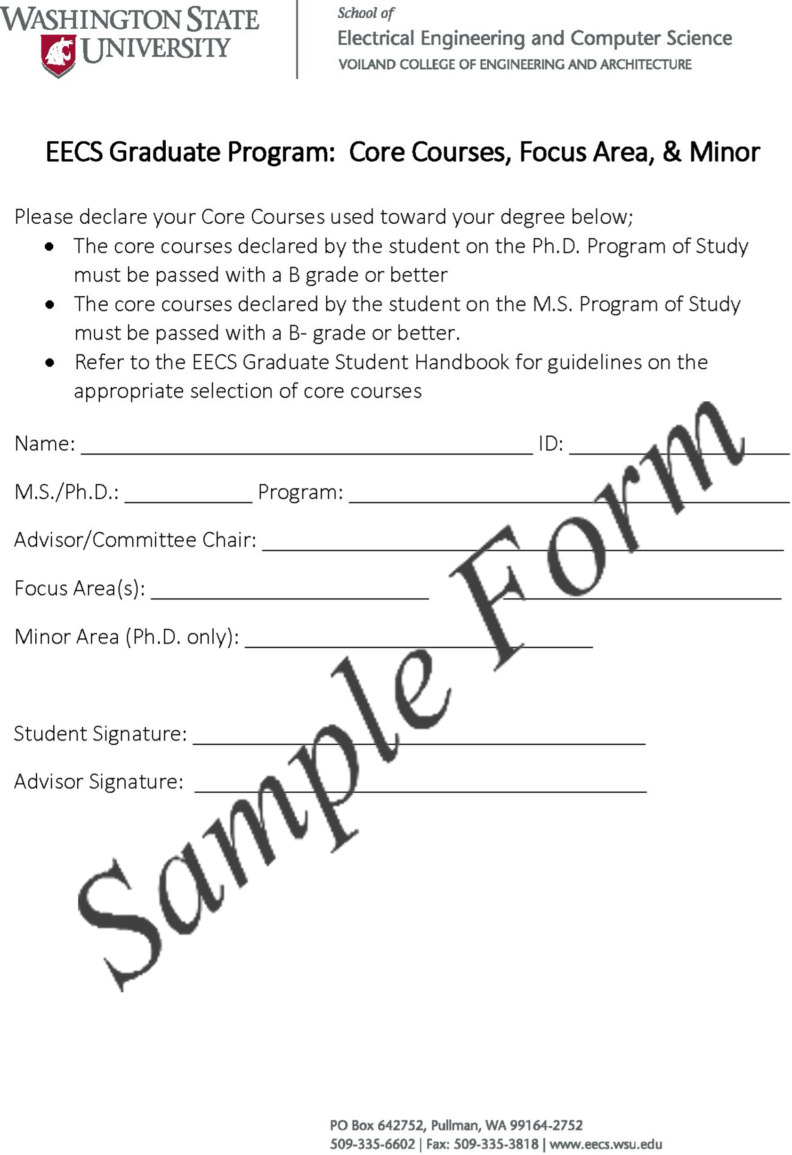
Directed Study Form
Must be submitted to the Graduate Program Coordinator before the end of the first week of the semester in which you wish to take Directed Study
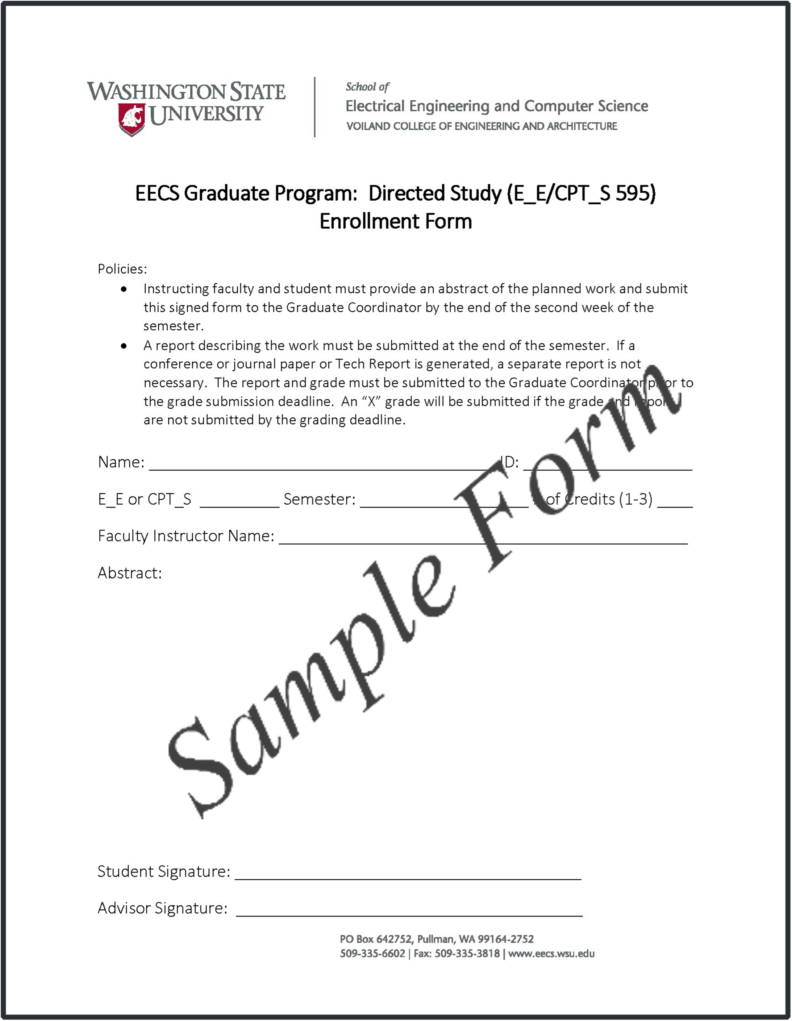
Computer Science QE Scheduling Form
Must be submitted during the beginning of a Computer Science Ph.D. student’s third semester; deadline will be clarified by the Graduate Program Coordinator.
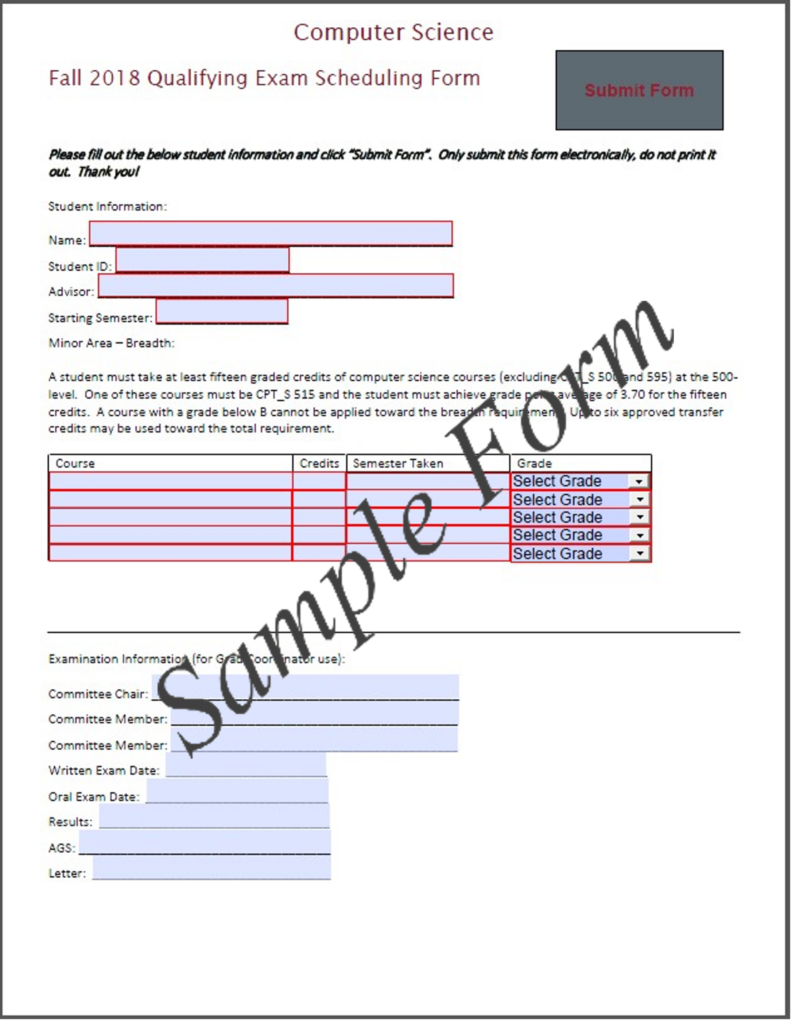
Electrical & Computer Engineering QE Scheduling Form
Must be submitted during the beginning of a Computer Science Ph.D. student’s third semester; deadline will be clarified by the Graduate Program Coordinator.
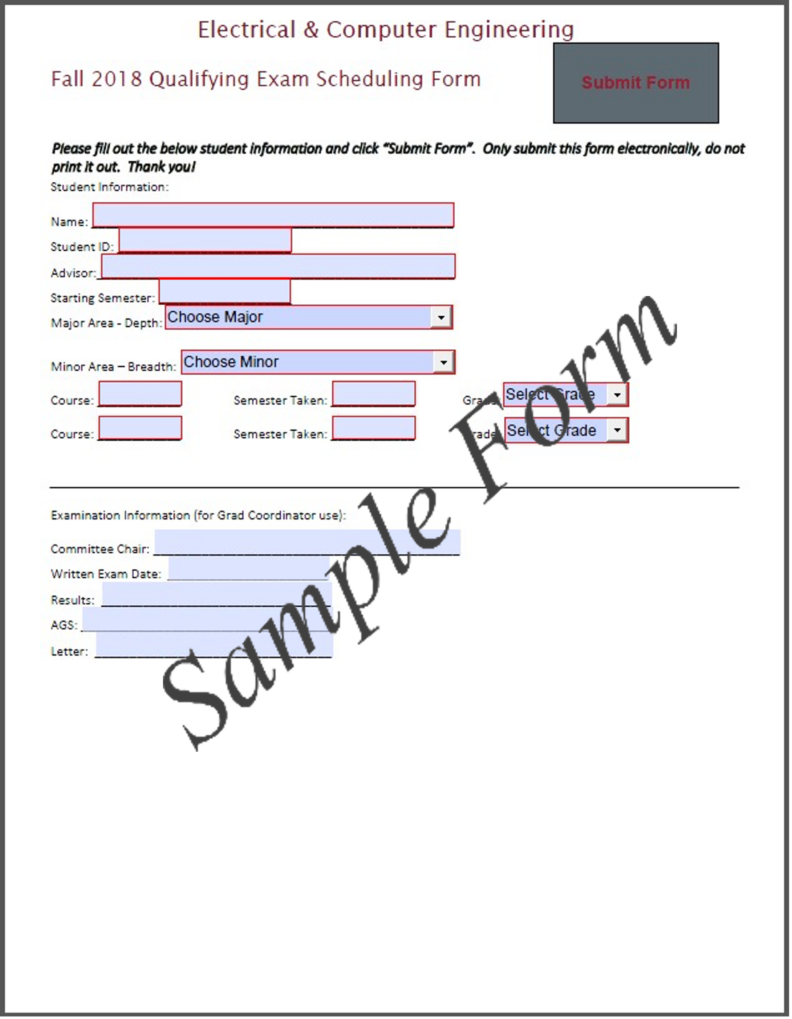
Petition to Transfer Graduate Coursework: Cover Page
Cover sheet for a transfer request, only one form needs to be submitted for a batch of requests.
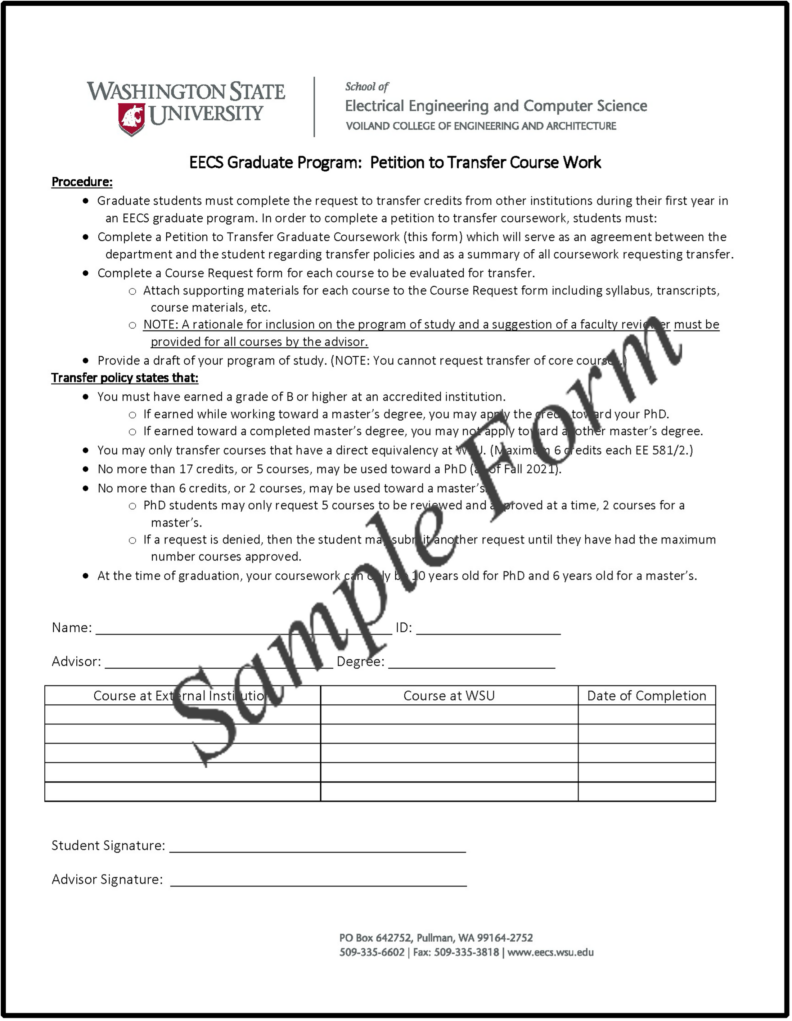
Petition to Transfer Graduate Coursework: Transfer Course Request Form
One copy is required for each course request, attach to course syllabus.
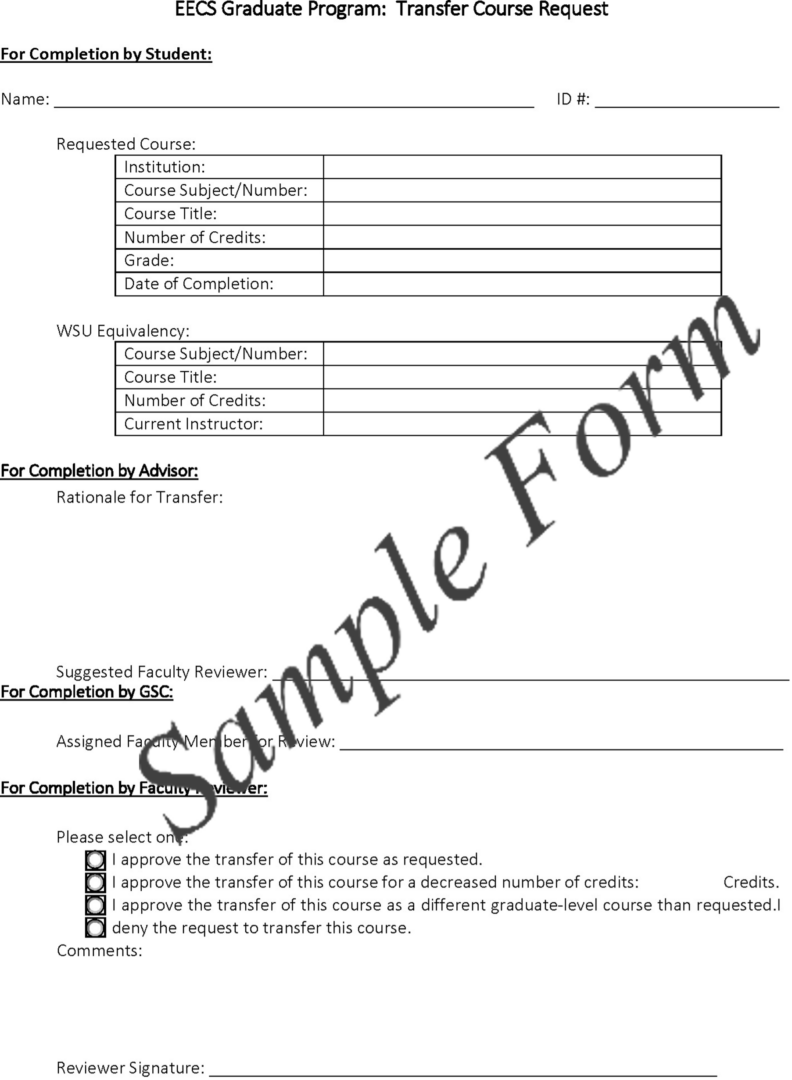
Petition to Transfer Graduate Coursework: Program of Study Draft
Students must submit a program of study draft with transfer requests; only one required per batch of requests.
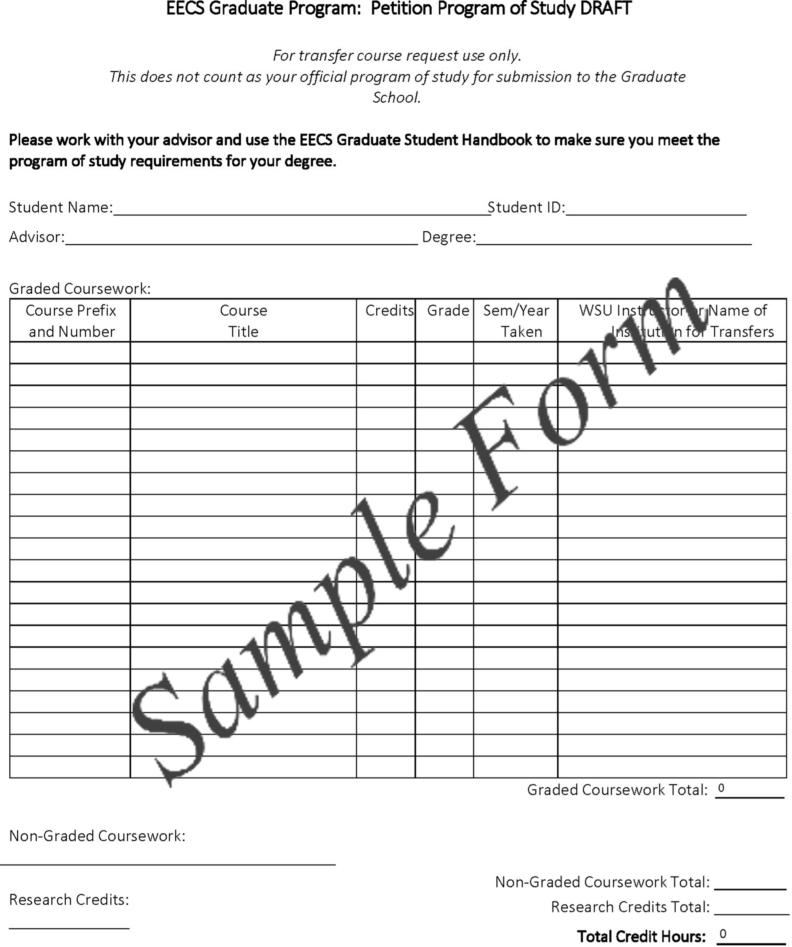
Publication List form
A list of publications is required with your submission of a Ph.D. preliminary exam scheduling form or Ph.D. doctoral defense scheduling form.